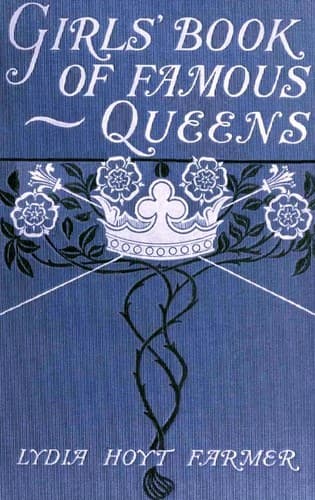
The Girls' Book of Famous QueensFarmer, Lydia Hoyt
History
The Girls' Book of Famous Queens
Farmer, Lydia Hoyt
Queens -- Biography -- Juvenile literature
“In the commencement of the reign of Anne, the Earl of Marlborough was
a Tory; but his wife became a Whig, and, as a natural consequence,
Marlborough was soon drawn over to that party. Admiral Churchill, his
brother, was a violent Tory; Lord Sunderland, his son-in-law, was a
violent Whig; Lady Tyrconnel, the sister of Lady Marlborough, was an
enthusiastic Jacobite, and was at this time one of the court of the
exiled king. This one instance will give some idea of the manner in
which not only the nation but private families were divided by the
spirit of faction.
“A continued series of disputes and intrigues agitated the country;
and among several minor events was the trial of Dr. Sacheverel for
preaching a seditious sermon, a circumstance unimportant in itself, but
which was made to serve the purposes of a faction, and to inflame the
populace almost to frenzy. Never, perhaps, did party spirit rage in a
manner at once so disgraceful, so vicious, and so ludicrous. It was
not the strife of principles; it was not, like the civil wars of the
preceding century, a grand struggle between liberty and despotism,—it
was a vile spirit of faction, which had filled the nation with spleen
and rancor, and extinguished the seeds of good-nature, compassion, and
humanity; which had affected at once the morals and the common sense of
the people; and even interfered with the administration of justice.
“The women, instead of tempering the animosities of the time, blew up
the flame of discord. Addison, in some of the most elegant papers of
the ‘Spectator,’ attempted to mitigate this evil spirit. He attacked
the men with grave humor and graver argument; he endeavored to bring
back the women to the decorum and reserve of their sex by the most
exquisite raillery, that delicate mixture of satire and compliment in
which he excelled; he reminded these petticoat politicians and viragoes
of the tea-table that party spirit was in its nature a male vice, made
up of many angry passions, which were altogether repugnant to the
softness, modesty, and other endearing qualities proper to their sex.
“He assured them there was nothing so injurious to a pretty face
as party zeal; that he had never known a party woman who kept her
beauty for a twelve-month; and he conjured them, as they valued their
complexions, to abstain from all disputes of this nature. Every one
will recollect the admirable description of the Whig ladies and the
Tory ladies drawn up in battle array at the opera, and _patched_, by
way of distinction, on opposite sides of the face; the perplexity of
the Whig beauty, who had a mole on the Tory side of her forehead, which
exposed her to the imputation of having gone over to the enemy; and the
despair of the Tory partisan, whom an unlucky pimple had reduced to the
necessity of applying a patch to the wrong side of her face.
Public-domain text, read in full here on John Shaqi.
Reviews
Reviews
No reviews yet
Be the first to share your thoughts on this work.
Elsewhere in the archive
Join the Discussion
Join the discussion
Sign in to leave a comment or review.
Sign InorCreate an account