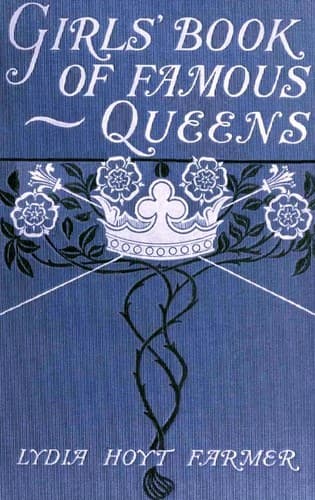
The Girls' Book of Famous QueensFarmer, Lydia Hoyt
History
The Girls' Book of Famous Queens
Farmer, Lydia Hoyt
Queens -- Biography -- Juvenile literature
“But it was all in vain; a transient smile might have been excited at
such palpable absurdity; some partial good was perhaps effected; but
fashion and faction were far too strong to be acted upon by wit, or
argument, or eloquence, or satire. At a time when a low-bred, artful,
ignorant bedchamber-woman, with no more sense than would have sufficed
to smooth a crumpled ribbon or comb a lapdog, possessed supreme power,
and Swift, Arbuthnot, Harley, and Bolingbroke were dancing attendance
in her anteroom, it was in vain to preach to women the forbearance and
reserve proper to their sex, to point out the confined sphere of their
duties, or to remind them of the advice of Pericles to the Athenian
women, ‘not to make themselves talked of one way or another.’ Mrs.
Masham ruled the queen, but she was herself the contemptible tool of a
set of designing men. In the end she and her tutor Harley triumphed;
the Tories prevailed; the Whigs were all turned out; Marlborough was
not only disgraced at court, but, by a sudden turn of feeling produced
in the popular mind by the calumnies and contrivance of his enemies,
he became an object of contempt and hatred; and he whose victories had
been hailed with such national pride and exultation, found himself
‘baited with the rabble’s curse.’ This might have been contemned, for
mere popular clamor dies away, and leaves no trace on the dispassionate
page of history; but when Swift, the political gladiator of that time,
collected all his terrible powers of invective and satire, and sarcasm,
and fell upon the devoted general, branding, stabbing, and slashing
at every stroke, he left the duke standing like a column scathed by
the thunderbolt, and the lapse of a century has hardly enabled us to
distinguish the truth from falsehood of his rancorous libels.”
The brilliant victories of the Duke of Marlborough, in alliance
with the German princes under Prince Eugene, had filled all Europe
with wonder. In 1704, the victory of Blenheim was achieved, and
notwithstanding Marshal Villars’ heroism at the battle of Malplaquet,
in 1709, the victory was gained by Marlborough and Prince Eugene,
though so great was the loss of the allies, that Villars wrote to Louis
XIV.: “If God permits us to lose such another battle, your Majesty can
count on your enemies being destroyed.”
Marlborough had joined the Whigs because they were in favor of war; but
now the Tories were gaining the ascendency in England; and with their
coming into power peace was declared, and the Marlboroughs were deposed
from their high places.
Public-domain text, read in full here on John Shaqi.
Reviews
Reviews
No reviews yet
Be the first to share your thoughts on this work.
Elsewhere in the archive
Join the Discussion
Join the discussion
Sign in to leave a comment or review.
Sign InorCreate an account