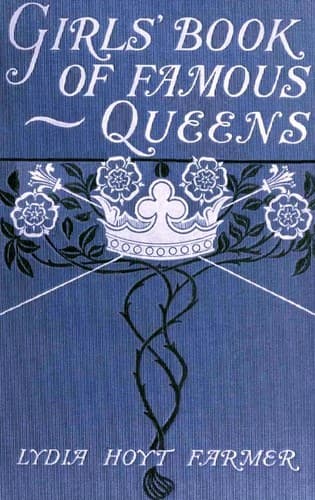
The Girls' Book of Famous QueensFarmer, Lydia Hoyt
History
The Girls' Book of Famous Queens
Farmer, Lydia Hoyt
Queens -- Biography -- Juvenile literature
Maria Theresa was possessed of great beauty and a fine presence. The
dignity of her exalted rank was worn with regal grace. “Her figure was
tall, and formed with perfect elegance; her deportment, imposing and
majestic; her features were regular; her eyes were gray, and full of
lustre and expression; she had the full Austrian lips, but her mouth
and smile were beautiful; her complexion was transparent; she had a
profusion of fine hair; and, to complete her charms, the tone of her
voice was peculiarly soft and sweet. Her strict religious principles,
or her early and excessive love for her husband, or the pride of
her royal station, or perhaps all these combined, had preserved her
character from coquetry. She was not unconscious of her powers of
captivation, but she used them not as a woman, but as a queen; not to
win lovers, but to gain over refractory subjects.”
It is recorded to her praise, “that she desired to be informed of every
act of the administration; that she afforded the poor and humble, as
well as the noble and rich, free access to her presence; that she
listened benignantly to all, either granting their petitions, or, if
she denied them, giving reasons for her refusal, without delusive
promises or vague evasions. During a forty years’ reign she invariably
showed a love of justice and truth; and she stated, as a principle
of her conduct, that it is only the pleasure of alleviating distress
and doing good to the people that can render the weight of a crown
supportable to the wearer.”
In the year 1765, the Emperor Francis I. died. His loss was sincerely
mourned by Maria Theresa, who was devotedly attached to her husband.
She ever after wore mourning for him, and frequently visited the
imperial mausoleum where he was entombed. In anticipation of her own
death she caused her coffin to be made, and secretly sewed upon her own
shroud. She was afterwards buried in the grave-clothes thus made by her
own hands.
Upon the death of the Emperor Francis, her eldest son received the
imperial crown as Joseph II. But Maria Theresa continued to hold the
first place in the government until her death.
Maria Theresa gloried in her power of being able to be a public
benefactor; it pleased her to bestow benefits. She richly deserved her
title of “Mother of her people”; and she declared just before her death
that, “if anything reprehensible had been done in her name, it was
certainly without her knowledge, as she had always desired the welfare
of her subjects.” Her annual private charities and donations amounted
to more than eighty thousand a year; and so great was her benevolence
that when her son Joseph was accused of not being generous, he replied:
“If I gave like my mother, we should soon have nothing left to give
away.”
Public-domain text, read in full here on John Shaqi.
Reviews
Reviews
No reviews yet
Be the first to share your thoughts on this work.
Elsewhere in the archive
Join the Discussion
Join the discussion
Sign in to leave a comment or review.
Sign InorCreate an account