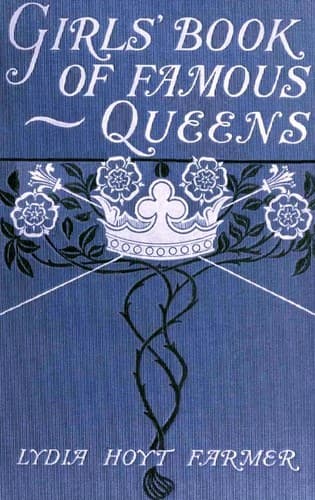
The Girls' Book of Famous QueensFarmer, Lydia Hoyt
History
The Girls' Book of Famous Queens
Farmer, Lydia Hoyt
Queens -- Biography -- Juvenile literature
The great blot upon the otherwise illustrious name of Maria Theresa
was her participation in the iniquitous partition of Poland. “She has
been rescued from the charge of having originated the unjust plan;
since the document of the secret convention, signed at St. Petersburg,
on the 17th of February, 1772, exists to prove the contrary; wherein
it is stated that if the court of Austria refuse consent to the plan
of partition, Prussia and Russia will combine against her. Amid the
general outcry that arose in Europe against the crowned spoliators,
Frederick the Great slyly observed: ‘As to me, I fully expected all
this uproar of blame; but what will they say of her saintship, my
cousin?’”
Maria Theresa was now at the height of her grandeur and power as
a sovereign. She had largely extended her territories. She had so
increased her revenues that, notwithstanding her immense expenses, she
laid by each year in her treasury two hundred thousand crowns. She
maintained an army of two hundred thousand men, and lived in harmony
with her ambitious and accomplished son, in whose name the imperial
power was vested. When war with Prussia was again threatening her
dominions, her skilful negotiations with Frederick the Great, which
resulted in the peace of Teschen, covered her name with glory and her
life with honor.
“Maria Theresa often declared that no event of her long reign had ever
caused her such unmingled satisfaction as the peace of Teschen.” It
was a peace bought without bloodshed. It was entirely her own work,
originated in her own benevolent heart. It was the means of continuing
to her kingdom the blessing of peaceful prosperity, and it surrounded
her dying head with a halo of glory.
Death had long been insidiously approaching this illustrious sovereign,
but she felt no alarm, and prepared to meet the end with calm
resignation. Dropsy had at length rendered her existence a continued
torture, and she welcomed the relief of death. Upon the last night of
her life she was engaged in signing papers and in giving necessary
directions to her successor. When her son urged her to rest, she
replied: “In a few hours I shall appear before the judgment-seat
of God, and would you have me sleep?” Upon expressing her anxiety
regarding those who had long been aided by her private charities, she
said: “If I could wish for immortality on earth, it would only be for
the power of relieving the distressed.”
A short time before she breathed her last her attendants thought
that she slumbered, as she had closed her eyes; and one whispered,
“The empress sleeps.” She immediately opened her eyes, saying with
impressive calmness: “No! I do not sleep; _I wish to meet my death
awake_!” Surely such a death-bed scene harmonized with the exalted and
illustrious life of Maria Theresa! She expired on the 29th of November,
1780, in her sixty-fourth year.
Her biographers justly style her the “_most blameless and beneficent
sovereign who ever wore a crown_.”
Public-domain text, read in full here on John Shaqi.
Reviews
Reviews
No reviews yet
Be the first to share your thoughts on this work.
Elsewhere in the archive
Join the Discussion
Join the discussion
Sign in to leave a comment or review.
Sign InorCreate an account