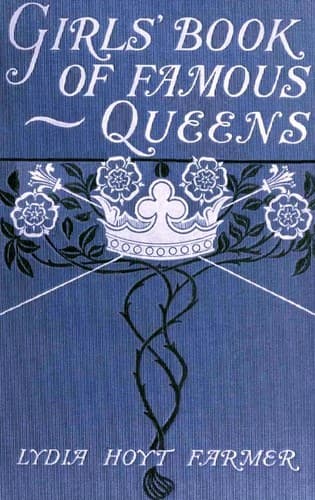
The Girls' Book of Famous QueensFarmer, Lydia Hoyt
History
The Girls' Book of Famous Queens
Farmer, Lydia Hoyt
Queens -- Biography -- Juvenile literature
The earthly dower of Maria Theresa was certainly the richest ever
granted to any female sovereign of the world. “A strong mind and
feeling heart, royalty and beauty, long life and prosperity, a happy
marriage, a numerous family, illustrious children, her people’s love,
and the admiration of the universe.”
CATHERINE II.
A.D. 1729-1796.
“Here’s to the flaunting, extravagant queen.”—SHERIDAN.
IN mighty Russia, that land of violent extremes, that land of lavish
wealth and utter poverty,—whose frightful climate conquered the
otherwise invincible Napoleon, and with its keen frosts snapped the
pillars of his throne; where millions tremble before a despot whose
will is fettered by no constitution; whose prisons are the ice realms
of Siberia, whither so many trains of wretched captives have passed
to linger hopelessly in living tombs; whose smouldering fires of
discontent and hatred, fanned by the ardent breath of Nihilism, are
constantly breaking out into rebellion and assassination,—in that
land of splendor and of barbarism, behold St. Petersburg, the city of
the Czars, founded by Peter the Great in 1703, and risen out of the
desolate marshes of Ladoga to be the worthy capital of a great empire.
[Illustration: CATHARINE II. OF RUSSIA.]
St. Petersburg, the city of palaces, with its royal and princely
residences, adorned with Doric, Ionic and Corinthian columns surmounted
by massive friezes, entablatures, and sculptures; with its Grecian and
Gothic temples, its great squares, its splendid, spacious streets,
its monuments, its warehouses and docks, its gardens and boulevards,
Cronstadt with its frowning bastions and painted spires, and in the
midst, giving to all an air of space, of freedom, and dignity, the
Neva, thronged by craft of all kinds and sizes, from the tiny
gondola to the man-of-war, and from the mighty merchant ship to the
rude barge laden with timber or with grain,—presents a scene of
opulence and magnificence which makes it difficult to realize that the
foundations of this great metropolis were placed in the quaking bogs of
Lake Ladoga.
Upon the bank of the Neva, midway between the Senate House and
the Admiralty, stands that most famous of the monuments of St.
Petersburg,—the equestrian statue of Peter the Great. A splendid
statue, this, of bronze and of colossal size. Peter, astride a mighty
charger, reins back his steed upon the brink of a precipice, and
stretches forth his sceptre, while he seems to survey with proud
triumph the wonderful growth of the city of which he is the “creator,”
and of which he might exclaim, as did Nebuchadnezzar of Babylon, “Is
not this great Petersburg, that I have built by the might of my power,
and for the honor of my majesty!”
Little did Peter think, when he laid aside the sceptre of his empire,
that five women would reign after him in almost direct succession, and
that the last, the greatest of them all, would rear to him this costly
monument upon the borders of the Neva.
Public-domain text, read in full here on John Shaqi.
Reviews
Reviews
No reviews yet
Be the first to share your thoughts on this work.
Elsewhere in the archive
Join the Discussion
Join the discussion
Sign in to leave a comment or review.
Sign InorCreate an account