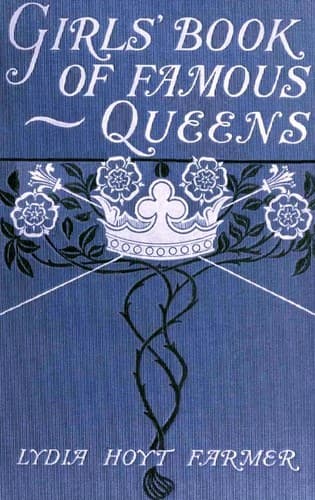
The Girls' Book of Famous QueensFarmer, Lydia Hoyt
History
The Girls' Book of Famous Queens
Farmer, Lydia Hoyt
Queens -- Biography -- Juvenile literature
In 1774 also, the empress-queen disgraced Gregory Orloff and raised to
the post of favorite and chief minister, Potemkin, afterward Prince
Potemkin, of infamous renown, who for more than twenty years held the
highest honors of the empire. He was neither a great statesman nor
a great general, but he was certainly an extraordinary man. He had
all the petulance, audacity, and wilfulness of a spoiled boy, yet he
possessed a genius fit to conceive and execute great designs. “His
character displayed a singular union of barbarism and grandeur, and of
the most inconsistent and apparently incompatible qualities. He was
at once the most indolent and the most active man in the world; the
most luxurious, and the most indefatigable; no dangers appalled and no
difficulties repulsed him; yet the slightest caprice, a mere fit of
temper, would cause him to abandon projects of vital importance. At one
time he talked of making himself king of Poland; at another of turning
monk or bishop. He began everything, completed nothing, disordered the
finances, disorganized the army, depopulated the country. He lived with
the magnificence of a sovereign prince. At one moment he would make an
aide-de-camp ride two or three hundred miles to bring him a melon or
a pineapple; at another he would be found devouring a raw carrot or
cucumber in his own antechamber.
“He scarcely ever opened a book, yet he learned everything, and forgot
nothing; his wonderful quickness in appropriating the knowledge of
others served him instead of study. Altogether his great qualities and
his defects precisely fitted him to obtain the ascendency over such a
mind as that of Catherine; she grew tired of others, but his caprices,
his magnificence, and his gigantic plans, continually interested and
occupied her.” Under his administration all things did not go on well,
we may be sure but all _went on_, and the empress was content.
The second Turkish war having ended in 1783 with the annexation of the
Crimea and Kuban, under the classic names of Taurida and the Caucasus,
Potemkin persuaded Catherine to go and admire herself in her new
dominions, a thing which she was only too ready to do.
So on the 18th of January, 1787, the imperial _cortège_ set out from
St. Petersburg. There were fourteen carriages upon sledges for the
empress and her court, and one hundred and sixty for the attendants
and baggage. Five hundred and sixty relays of horses waited them at
every post, and the luxurious carriages flew over the frozen plains at
the rate of a hundred miles a day. Wherever they stopped, a temporary
palace was erected for the empress, fitted with every luxury, and
arranged, as much as possible, like her palace at St. Petersburg. When
they arrived at Khief, the empress embarked on the Dnieper, and with a
fleet of fifty galleys sailed down the river to Cherson.
Public-domain text, read in full here on John Shaqi.
Reviews
Reviews
No reviews yet
Be the first to share your thoughts on this work.
Elsewhere in the archive
Join the Discussion
Join the discussion
Sign in to leave a comment or review.
Sign InorCreate an account