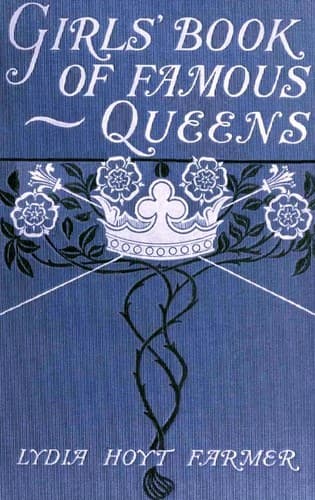
The Girls' Book of Famous QueensFarmer, Lydia Hoyt
History
The Girls' Book of Famous Queens
Farmer, Lydia Hoyt
Queens -- Biography -- Juvenile literature
Here money, provisions, and troops had been conveyed from every part
of the empire. The Borysthenes was covered with magnificent galleys; a
hundred and fifty thousand soldiers were newly equipped; deserts were
peopled for the occasion, and palaces reared for the empress queen in
the midst of trackless wilds.
The king of Poland came to do her homage, and the Emperor Joseph
was content to mingle among the herd of her courtiers and swell the
splendor of her state.
Catherine herself scattered diamonds and honors with her usual
liberality. “In her travelling-carriage she had a large, green sack,
full of gold coins, and her courtiers were kept busy throwing handfuls
out of the window to the people, who lay grovelling on the earth as
her carriage passed by.”
After six months spent in this sort of travelling, the empress returned
to St. Petersburg.
As a refuge from the cares of state, Louis XIV. had built his Trianon,
and Frederick the Great his Sans-Souci, and Catherine II., oppressed
like them, reared the splendid palace of the Hermitage, within whose
portals she laid aside the imperial diadem of all the Russias, and
became a patron of literature and the fine arts.
Beneath a great portal, supported by colossal granite giants, is the
entrance to this Hermitage, over whose steps have often passed those
discarded favorites of the empress-queen, smothering under forced
smiles and honeyed words their inward rage and indignation; for when
Catherine wearied of her favorites she sent them an order to travel.
“I am tired of him,” she would say; “his ignorance makes me blush. He
can speak nothing but Russian. He must travel in France and England to
learn other languages.” The courtier who received this intelligence was
not long in preparing his travelling-carriage.
At the Hermitage, Catherine surrounded herself with men of letters.
Here were Lomonozof, the poet; Sumorokof, the dramatic author;
Kheraskof, the writer of tragedies; Sherebetoff, the historian; and
Pallas, the naturalist.
She especially affected the friendship of French writers. She
entertained Diderot with royal magnificence, and purchased his library;
she gave the education of her grandsons, Alexander and Constantine,
to the care of the republican Laharpe; and she kept up a constant
correspondence with Voltaire. Catherine, herself, had no real love for
the arts; but she patronized them all as subservient to her glory and
her power.
“Thus she not only had no taste for music, but she was destitute
of ear to distinguish one tune from another, as she often frankly
acknowledged; but nothing less would serve her than an Italian _corps
d’opera_ attached to her domestic establishment. She had no taste for
painting, yet she purchased at a high price some beautiful collections,
and in the gallery of her palace of the Hermitage hung some magnificent
specimens of the Italian and Flemish schools, purchased in France and
Italy.”
Public-domain text, read in full here on John Shaqi.
Reviews
Reviews
No reviews yet
Be the first to share your thoughts on this work.
Elsewhere in the archive
Join the Discussion
Join the discussion
Sign in to leave a comment or review.
Sign InorCreate an account