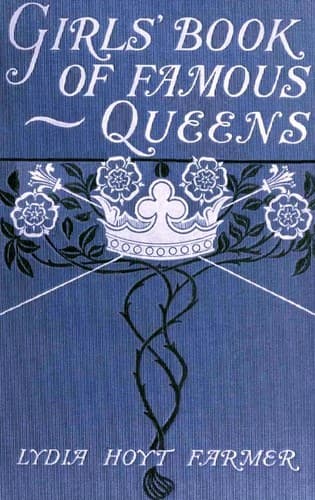
The Girls' Book of Famous QueensFarmer, Lydia Hoyt
History
The Girls' Book of Famous Queens
Farmer, Lydia Hoyt
Queens -- Biography -- Juvenile literature
And when her sister and her maidens, coming in haste, looked upon the
pile, lo! she had fallen upon the sword, and the blood was upon her
hands. Then a great cry arose throughout the palace, and Anna, rushing
through the midst, called upon her name: “O my sister, was this thy
purpose? Were the pile and the sword and the fire for this?” Then she
climbed upon the pile and took her sister in her arms and sought to
stanch the flowing blood. Three times did Dido strive to raise her
eyes; three times did her spirit leave her. Then Juno, looking down
from heaven and perceiving that her pain was long, in pity sent down
Iris, her messenger, that she might loose the soul that struggled to
be free. For, seeing that she died not by nature, nor yet by the hand
of man, but before her time and by her own madness. Queen Proserpine
had not shred the ringlet from her head which she shreds from them who
die. Wherefore, Iris, flying down with dewy wings from heaven, with a
thousand colors about her from the light of the sun, stood above her
head and said, “I give thee to death, even as I am bidden, and loose
thee from thy body.” Then she shred the lock, and Queen Dido yielded up
her mortal spirit.
Once more Æneas met Queen Dido when he was permitted by the gods to
descend into the land of shadows, where dwelt the shades of the dead.
When Æneas and the Sibyl, who conducted him thither, came to the river
Styx, then was the Boatman Charon persuaded to ferry them over, for the
Sibyl showed him the marvellous bough of gold, a gift intended for the
Queen of Hades; and the huge, terrible watch-dog Cerberus, which guards
the portals to the Land of Shadows, was tamed by eating of the cake the
Sibyl gave, made of honey and poppy-seed, causing sleep.
Thus did they come within the Mourning Fields, where dwell the souls of
those who have died of love. Among these shades was Dido, fresh from
the wound wherewith she slew herself. And when Æneas saw her darkly
through the shadows, he wept and cried: “O Dido! it was truth, then,
that they told me,—that thou hadst slain thyself with the sword? Loath
was I, O Queen,—I swear it,—to leave thy land. But the gods constrained
me; nor did I think that thou wouldst take such sorrow from my
departure. But stay! depart not; for never again may I speak to thee,
but this time only.”
But Dido cast her eyes upon the ground, and her heart was hard against
him, even as a rock. His tears and groans and sighs and friendly words
moved not her spirit, nor could appease her wrath. Silent and scornful
she departed to the grove that was hard by, where dwelt her first
husband, Sichæus, who gave her love, even as he was loved by her.
Thus was the love of Dido, which Æneas had slighted, avenged. And
herewith endeth the poet’s story of the famous Queen Dido, in which he
telleth of her fame and beauty and unhappy love and direful death.
CLEOPATRA.
69-30 B.C.
Public-domain text, read in full here on John Shaqi.
Reviews
Reviews
No reviews yet
Be the first to share your thoughts on this work.
Join the Discussion
Join the discussion
Sign in to leave a comment or review.
Sign InorCreate an account