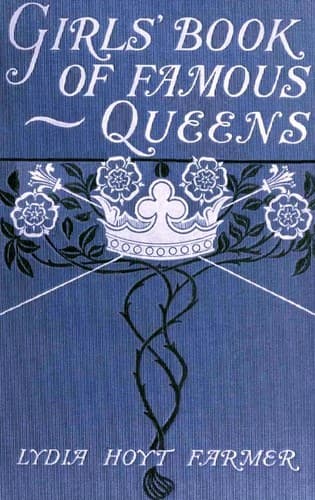
The Girls' Book of Famous QueensFarmer, Lydia Hoyt
History
The Girls' Book of Famous Queens
Farmer, Lydia Hoyt
Queens -- Biography -- Juvenile literature
The people, indeed, regarded the young monarch as the “hope of the
nation,” and named him “_Louis le Desire_,”—a testimony to the ardor
with which they had looked forward to his accession. And it is probable
that, had a more able pilot—“a king more a king” than that feeblest
of monarchs, Louis XVI.—been called to the helm at that period, “the
vessel of state might have been safely guided through the shoals and
quicksands surrounding her, and escaped the eddies of that devastating
whirlpool in which she was eventually engulfed.” Indeed, if sincerely
wishing to see his people prosperous and happy could have made them
so, France would have had no more beneficent ruler than Louis XVI. But
his good wishes and intentions were rendered of no avail by his utter
want of energy and ability to carry them out. Infirm of purpose at the
first, he remained so to the end. The decree, “Let there be light,”
unfortunately, never went forth to quicken his mental faculties. The
queen, on the other hand, possessed all the courage and resolution of
her imperial mother, Maria Theresa; and, had she been able to control
affairs, the revolution would have been crushed in its infancy with
an iron hand. Again, had the king been able to hold to his milder
measures, to maintain on the following day that which he had declared
the day before, it is possible that France might have passed quietly
from an absolute to a constitutional monarchy. But the self-will
and determination of the one, and the weakness and instability of
the other, rendered a union of ideas impossible and the revolution
inevitable.
Little was known by the nation at large of the mental qualities of the
young king. He was now in his twentieth year; and it had been noised
among the people that he had inherited all the virtues of his father,
“_Le Grand Dauphin_” to which were added the frugal tastes, the genial
temper, and the air of _bonhomie_ to which the gallant Henry IV. owed
so much of his popularity.
“No wonder, then, that the accession of Louis XVI. was hailed
throughout France with general delight, or that the enthusiastic
people—their many expected reforms already conceded in
imagination—should have written in conspicuous characters,
‘RESURREXIT,’ beneath the statue of the gallant Henry, whose jovial
humor and pliant conscience enabled him to gratify his Catholic
subjects with his presence at a _Te Deum_.”
When the king made his public entry into the capital, the joyous
demonstrations of the Parisians affected him deeply. “What have I
done,” he exclaimed, “that they should love me so much?” Ah, Louis! you
have as yet done nothing; but much, very much, is expected from you!
But Louis XVI. possessed no energy; and the torpid action of his mind
was but too plainly evinced by the sluggish inactivity of his heavy
frame, as, stolid in his immense corpulence, he sat lolling in his
chariot.
Public-domain text, read in full here on John Shaqi.
Reviews
Reviews
No reviews yet
Be the first to share your thoughts on this work.
Elsewhere in the archive
Join the Discussion
Join the discussion
Sign in to leave a comment or review.
Sign InorCreate an account