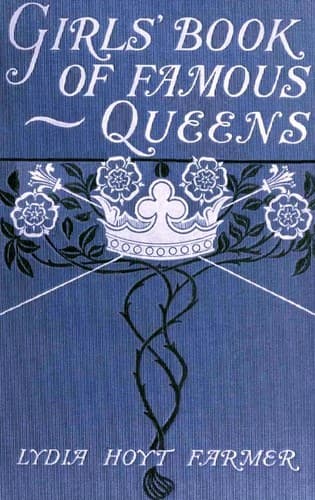
The Girls' Book of Famous QueensFarmer, Lydia Hoyt
History
The Girls' Book of Famous Queens
Farmer, Lydia Hoyt
Queens -- Biography -- Juvenile literature
Perhaps, in their eagerness for reforms, the Parisians displayed
unreasonable impatience. But when, a few weeks later, the young
monarch again passed through Paris, he remarked—though unfortunately
the lesson was lost on him—that the acclamations of the people were
far less frequent and fervid than on the former occasion. And his
eyes were filled with tears when he perceived that the conspicuously
displayed “RESURREXIT” was transferred from the statue of the gallant
Henry to that of the slothful Louis XV. Still, with all his vices,
Louis the Well-Beloved, on those rare occasions when he appeared in
public, had always commanded the respectful homage of his subjects,
simply by the dignity of his bearing. By the same means he imposed
silence on his courtiers, when, in license of speech, they infringed
the limits within which it was sometimes his _bon plaisir_ to restrain
them. Occasionally, too, when the parliament opposed his edicts, or
the dissentient opinion of a minister roused him from his habitual
indolence, he could at once assume the arbitrary tone, the “_je le
veux_” of the absolute monarch, and carry out his purposes with all
the _hauteur_ of his royal ancestor, the _Grand Monarque_. “And it is
probable that his handsome person and majestic air—for, whatever may
have been his shortcomings in other and more essential qualities, in
appearance he was every inch a king—may have gone far in preventing
the utter extinction of the enthusiastic affection which on several
occasions during his reign the people so singularly, yet so generally,
expressed towards the royal _débauché_. A lingering spark of that
once ardent feeling must have smouldered on in their hearts to the
end; for, grievously oppressed though they were, and vicious as they
knew him to be, they still toiled on under their burdens, not exactly
uncomplainingly, yet in a spirit of toleration towards him; while the
yearned-for relief was, as if by the tacit consent of his subjects,
to be claimed only from his successor.” Truly, indications were not
wanting of the approaching storm. But “_Après nous le deluge!_” cried
Madame de Pompadour, gayly; and the king and the court echoed the cry.
Madame la Marquise was right. The deluge came; and the royal authority
which Richelieu, Mazarin, and Louis XIV. had raised to such gigantic
heights, and which Louis XV. had so shamefully abused, was hurled
prostrate in the dust.
Public-domain text, read in full here on John Shaqi.
Reviews
Reviews
No reviews yet
Be the first to share your thoughts on this work.
Elsewhere in the archive
Join the Discussion
Join the discussion
Sign in to leave a comment or review.
Sign InorCreate an account