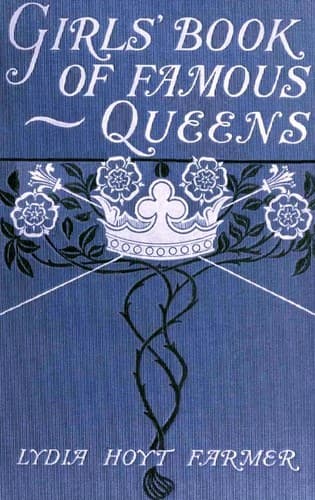
The Girls' Book of Famous QueensFarmer, Lydia Hoyt
History
The Girls' Book of Famous Queens
Farmer, Lydia Hoyt
Queens -- Biography -- Juvenile literature
One winter’s morning, Marie Antoinette, who was partially disrobed, was
just about to put on her body linen. The lady-in-waiting held it ready
unfolded for her. The _dame d’honneur_ entered. Etiquette demanded that
she should present the robe. Hastily slipping off her gloves, she took
the garment, but at that moment a rustling was heard at the door. It
was opened, and in came Madame la Duchesse d’Orleans. She must now be
the bearer of the garment. But the laws of etiquette would not allow
the _dame d’honneur_ to hand the linen directly to Madame la Duchesse.
It must pass down the various grades of rank to the lowest, and by her
be presented to the highest. The linen was consequently passed back
again from one to another, till it was finally placed in the hands
of the duchess. She was just upon the point of conveying it to its
proper destination, when suddenly the door opened, and the Comtesse de
Provence entered. Again the linen passed from hand to hand until it
reached Madame la Comtesse. She, perceiving the uncomfortable position
of the queen, who sat shivering with cold, without stopping to remove
her gloves, placed the linen upon her shoulders. Her Majesty, however,
was quite unable to restrain her impatience, and exclaimed, “How
disagreeable, how tiresome!” Such was the etiquette of the court of
Versailles, and its inexorable rules governed alike every action in the
lives of the king and queen, while the cavaliers and _grandes dames_
observed with the greatest minuteness every punctilio of _la grande
politesse et la grande galanterie_, that by so doing they might widen
the gulf already existing between them and the new ideas of _liberté_
and _égalité_ which were beginning to pervade the realm.
“You love flowers; I give you a bouquet of them by offering you Le
Petit Trianon entirely for your own private use. There you may reign
sole mistress; for the Trianons, by right, belong to you, having always
been the residence of the favorites of the kings of France.” For Louis
XVI. this speech was a great effort of gallantry. It delighted Marie
Antoinette. Here, then, was that for which she had so often longed;
a place to which she could retire from the cares of state, and throw
aside the pomps and punctilios of etiquette. She loved not the grand
old gardens of Versailles, with their terraces and clipped yews. She
would have an English garden of the day, with its thickets, waterfalls,
and rustic bridges, such as the Prince de Ligny had made at _Bel-œil_
and the Marquis de Caraman at Roissy. _Le grand simple_ is to take the
place of _le grand magnifique_, and attired in white muslin, with a a
plain straw hat, and followed by a single attendant, the queen roams
through the gardens and groves of the Petit Trianon. Through the lanes
and byways she chases the butterfly, picks flowers free as a peasant
girl, and leaning over the fences, chats with the country maids as they
milk the cows.
Public-domain text, read in full here on John Shaqi.
Reviews
Reviews
No reviews yet
Be the first to share your thoughts on this work.
Elsewhere in the archive
Join the Discussion
Join the discussion
Sign in to leave a comment or review.
Sign InorCreate an account