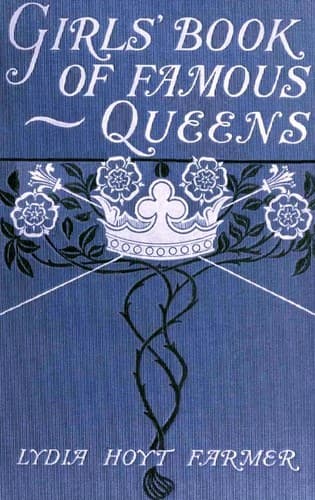
The Girls' Book of Famous QueensFarmer, Lydia Hoyt
History
The Girls' Book of Famous Queens
Farmer, Lydia Hoyt
Queens -- Biography -- Juvenile literature
This freedom from restraint was etiquette at the court of Vienna; it
was barbarism at the court of Versailles. The courtiers were amazed,
the ceremony-stricken dowagers were shocked; and Paris, France, and
Europe, were filled with stories of the waywardness and eccentricities
of Marie Antoinette. And Mesdames, the king’s aunts, from their retreat
at Bellevue, and Madame du Barry, from her domain of Luviciennes, lost
no opportunity to gather reports unfavorable to the reputation of the
queen, and spread them far and wide.
Still another surprise was in store for the nobility, for upon one
occasion, at Trianon, when the queen seated herself, she requested in a
lively, nonchalant manner the whole of the ladies, without distinction,
who formed her intimate circle, to seat themselves also! What a blow to
those who held so dear the privileges they derived from distinction of
office and superiority of rank! _La haute_ and _la petite noblesse_,
in spite of their cherished distinctions, _all_ are to sit down
together! It is terrible! How many enemies are made, and allies added
to the circles at Bellevue and Luviciennes, by that little act! Poor
thoughtless Marie Antoinette!
But she proposed to reign at Trianon, not as queen of France, but
simply as a lady of the manor, surrounded by her friends. And so
she built the Swiss cottages, with their thatched roofs and rustic
balconies; for it was her good pleasure that she, her king, and her
friends, should be country people for the nonce. The queen’s cottage
stood in the centre, and she was the _fermière_. The king was the
miller, and occupied the mill, with its joyous tick-tack. Monsieur le
Comte de Provence, figured as schoolmaster, while the Comte d’Artois
was in his element as gamekeeper. However, one may be sure that these
simple country folk had no want of retainers to do their behests. In
the dairy, where the cream was put in the blue and white porcelain of
Trianon, on marble tables, diligent dairymaids skimmed and churned,
and displayed fresh butter and eggs. Down by the lake were more
masqueraders,—washerwomen this time; and Madame la Comtesse de Chalons
beat the clothes with ebony beaters. In the stable, the sheep,
unconscious of the honor to be done them, stood ready for clipping with
golden shears. “The Duc de Guines might not assist at this, because he
was so stout and so desperately bent on resorting to art to restrain
his bulk, that his valet, in selecting his master’s garments every
morning, was fain to ask, ‘Does my lord the Duke sit down to-day?’
But there were other helpers,—the big, jovial Duc de Coigny, and the
rough-voiced, stiff-jointed Comte d’Adhémar, who could, at least,
hoist sacks of corn up the mahogany steps to the granary.” _Madame la
Fermière_ distributed refreshments as she overlooked and encouraged her
workers. And so the dainty work, which was the idlest pastime, went on
to the accompaniment of gay jests and rippling laughter.
Public-domain text, read in full here on John Shaqi.
Reviews
Reviews
No reviews yet
Be the first to share your thoughts on this work.
Elsewhere in the archive
Join the Discussion
Join the discussion
Sign in to leave a comment or review.
Sign InorCreate an account