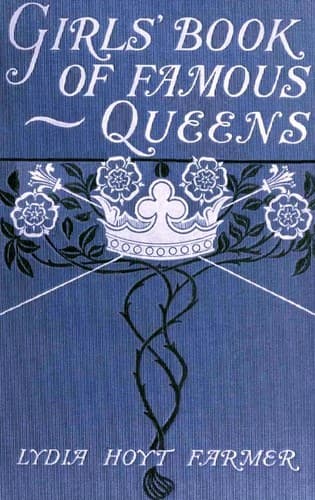
The Girls' Book of Famous QueensFarmer, Lydia Hoyt
History
The Girls' Book of Famous Queens
Farmer, Lydia Hoyt
Queens -- Biography -- Juvenile literature
On the 22d of October, 1781, a child is born at Versailles. The king
advances towards the queen’s couch; with a profound bow, and in a
voice that falters with emotion, he exclaims, “Madame, you have
fulfilled the dearest wishes of my heart and the anxious hopes of the
nation; you are the mother of a _Dauphin_.” Nothing could exceed the
public rejoicings; the triumph became well-nigh frantic. For it is
recorded that their superabundant joy found expression in a sort of
delirium,—people of all grades, and who had no previous acquaintance
with each other, indulging in fraternal embraces in the street. The
king himself went through a similar display of excessive joy. He
laughed, he wept, the tears streaming down his fat face. He ran in and
out of the antechamber, presenting his hand to kiss or to shake—or
both, if they pleased—to all and each indiscriminately, from the
solemn _grandees_, who were there to attest the birth, to the humblest
lackey in attendance. “The royal infant, splendidly arrayed and with
the grand cross of St. Louis on his breast, was placed in his satin
and point-lace bassinet to receive the homage of the great officers of
state. It is recorded that he replied in a most suitable manner to the
many flattering speeches addressed to him; and this being the first
opportunity he had had of exhibiting the power of his lungs, he availed
himself of it freely.” Madame Royale had been born three years before;
two other children were subsequently added,—the Duc de Normandie, and
the Princess Sophie; but only Madame Royale and the Duc de Normandie
were destined to survive to endure those woes which eventually
overwhelmed the royal family.
Marie Antoinette was now in the flower of her beauty, on which French
biographers love to dwell. Tilly said, “Her eyes recalled all the
changes of the waves of the sea, and seemed made to reveal and reflect
the blue of the sky.” Her fine throat and the lofty carriage of her
head were remarkable; and she once said, laughingly, to Madame Le
Brun, “If I were not a queen, should not I look insolent?”
“As one would have offered a chair to another woman, one would have
offered a throne to her; and when she descended the marble staircase
at Versailles, preceded by the officers who announced her approach,
saluted in the great court by the beating of drums and the presentation
of arms, all heads were uncovered respectfully, all hearts were filled
with admiration of the woman, as well as with loyalty to the queen.”
Public-domain text, read in full here on John Shaqi.
Reviews
Reviews
No reviews yet
Be the first to share your thoughts on this work.
Elsewhere in the archive
Join the Discussion
Join the discussion
Sign in to leave a comment or review.
Sign InorCreate an account