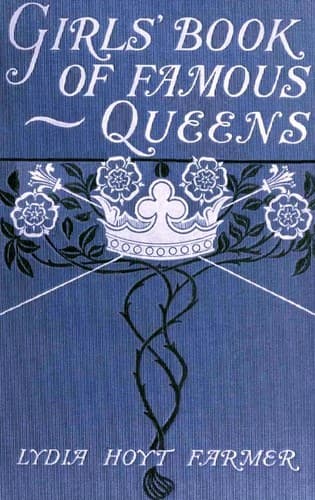
The Girls' Book of Famous QueensFarmer, Lydia Hoyt
History
The Girls' Book of Famous Queens
Farmer, Lydia Hoyt
Queens -- Biography -- Juvenile literature
This descent from the throne, which was so congenial to the queen, was
loudly condemned. In their first efforts for reform the people had
no wish to detract from the hereditary splendor of the crown, or the
“divinity,” which for so many centuries had hedged the kings of France.
It was the king and queen who took the first steps. Winter comes, and
with it a heavy fall of snow, and Marie Antoinette longs again for
the merry sleigh rides of Vienna. “The old court sledges are brought
forth—these being professedly economical times—for examination as to
their possibly serviceable condition. A glance, however, suffices
to show that disuse and neglect have put them completely _hors de
service_.” So new ones of great magnificence are prepared, with
“abundance of painting and gilding, trappings of embroidered crimson
leather and velvet, with innumerable tinkling bells of gold or silver.”
The horses, with nodding plumes and gorgeous caparisons, dazzled the
eyes of the Parisians as they swept through the Champs Élysées, drawing
their loads of lords and ladies enveloped in furs. The people frowned
disapprovingly. It was a new amusement—an innovation; and angry,
envious tongues declared that the “_Autrichienne_ had taken advantage
of the rigor of the season which had caused such widespread misery to
introduce her Austrian pastimes into the capital of France.”
Marie Antoinette was imprudent, very imprudent; that was her only
crime. But much allowance must be made for one, who, at the age
of fifteen years, was made _la premiere dame_ in a court the most
gorgeous, and, after that of Catherine II. of Russia, the most
dissolute, in Europe.
The people had already begun to compute the cost of equipages, palaces,
crown jewels, and courtiers. And some few of the _grands seigneurs_,
even, had begun to recognize the growing power of the _vox populi_;
but Marie Antoinette did not yet know that public opinion was of any
importance to her. “The slanderous tongues of Mesdames and the pious
circle of Bellevue, the innuendoes of Luviciennes, and the insidious
attacks of Monsieur le Comte de Provence,—all this she understood, and
resented. It seemed a matter of course that it should be thus; but the
right of the _people_ to interfere with her amusements and to call in
question their propriety, was something she could not understand.”
Alas! poor queen; the dreadful significancy of that expression “THE
PEOPLE,” and the vengeful acts to which an infuriated populace could be
driven, were two terrible lessons she had yet to learn.
Public-domain text, read in full here on John Shaqi.
Reviews
Reviews
No reviews yet
Be the first to share your thoughts on this work.
Elsewhere in the archive
Join the Discussion
Join the discussion
Sign in to leave a comment or review.
Sign InorCreate an account