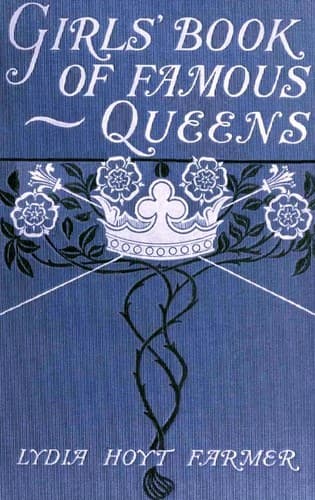
The Girls' Book of Famous QueensFarmer, Lydia Hoyt
History
The Girls' Book of Famous Queens
Farmer, Lydia Hoyt
Queens -- Biography -- Juvenile literature
Here for two long, weary months the poor queen lingered; her misery
being slightly alleviated by the kind-heartedness of Madame Richard,
the wife of the jailer, and Rosalie Lamorlière, an inmate of the
prison, who did all the rigorous rules allowed them to mitigate her
woes. “The night of her arrival at the Conciergerie the queen had not
so much as a change of linen. For days she begged to be allowed some,
but it was not till the tenth day that her prayer was granted, when
Michonis went to the Temple and brought back with him a parcel of linen
and some clothes; among others, the white gown which the queen wore on
the day of her execution. Little by little everything was taken from
the queen. The souvenirs of her happy past, to which she clung, were
taken from her; first her watch, a gift of her mother’s, and which had
never left her since she left Vienna,—the watch which had counted the
happy hours of her youth and womanhood was taken from her. Bitterly
she wept at having to part with it, as if it had been a friend. There
was not a moment that the queen could be out of sight of her _gens
d’armes_; a little screen, four feet high, was the only separation
between the space in which she changed her dress and those men.”
Imagine the misery of this state for a woman so delicately nurtured, so
luxuriously brought up, having at her command a household of over four
hundred persons, and accustomed to the refinements of the most polished
court in Europe.
In the old days of splendor at Versailles, when her attendants were
unable to find some article of dress or toilet, she had exclaimed
pettishly: “How _terrible_ it is not to be able to find what one
wants!” But now, in these last days of her life, when surrounded by
every aggravation that could wound a proud spirit, treated like the
worst of offenders, insulted as mother, wife, queen, and woman, she
never uttered one word that could be construed into petulance, or gave
one angry look.
“With threads taken from her bedding, she worked a kind of garter, and
not being allowed any knitting-needles, used a pair of toothpicks.
When finished, she dropped it, with a significant look, when her
jailer entered the prison. It reached—thanks to one of her loyalest
followers, M. Hue, a faithful servant of Louis XVI.—its destination,
for he gave it to Madame Royale when he accompanied her, two years
later, to Vienna.” This was the richest legacy the daughter of Maria
Theresa and the queen of France could bequeath to her child. The queen
was not so fortunate with another little relic that she hoped her
daughter would receive. This consisted of a pair of gloves and a lock
of her hair, which she slipped into the jailer’s hand; but the action
was observed by one of the _gens d’armes_, and the little parcel was
confiscated. “The damp of the queen’s underground prison was such that
her black gown began to fall into rags. She had another,—a white one;
but this she wore only on the day of her death.
Public-domain text, read in full here on John Shaqi.
Reviews
Reviews
No reviews yet
Be the first to share your thoughts on this work.
Elsewhere in the archive
Join the Discussion
Join the discussion
Sign in to leave a comment or review.
Sign InorCreate an account