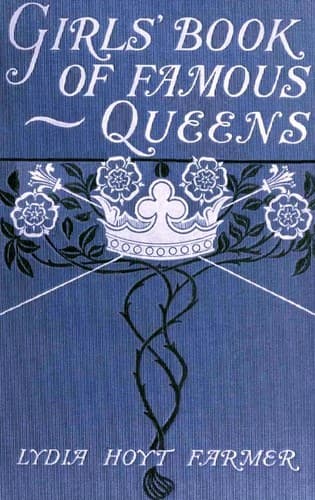
The Girls' Book of Famous QueensFarmer, Lydia Hoyt
History
The Girls' Book of Famous Queens
Farmer, Lydia Hoyt
Queens -- Biography -- Juvenile literature
“The few other clothes she had were in a deplorable state, and
required constant repair. She was only permitted three shirts, but the
revolutionary tribunal decided that but one of these should be given
to the queen, and worn ten days before another was allowed her; even
her handkerchiefs were only allowed one by one, and a strict account
was kept of every article as it came from or entered her prison.” Not
being allowed a chest of drawers she placed her clothes in a paper box
that Rosalie brought her, “and which she received,” says Rosalie, “as
if it had been the most beautiful piece of furniture in the world.”
Rosalie also procured her a little looking-glass, bordered with red,
with little Chinese figures painted on the sides. This too seemed much
to please the queen; and doubtless it gave her more satisfaction than
had done all the miles of gorgeous, gilded mirrors at Versailles.
And now the 14th of October has come, and Marie Antoinette is summoned
to appear before her judges. There are wretches present who cry as she
enters, “_À bas l’Autrichienne!_” Yet even the fear of the guillotine
is not able to check the visible signs of pity and deep-felt sympathy
her appearance elicits in others.
How startlingly the sorrowful present contrasts with the gay and
brilliant past, when, in her bridal dress of satin, pearls, and
diamonds, the Duc de Cossé-Brissac led her to the balcony of the
Tuileries to gratify the eager desire of the dense multitude to see
her, and bade her behold in them two hundred thousand adorers, while
shouts of “_Vive la Dauphine!_” rent the air. Marie Antoinette was
then a youthful bride. Twenty-three years have passed away, and she
is now a widow. In a faded black dress, she stands in the theatre of
that same palace of the Tuileries, amidst a throng of _canaille_, to
be tried for her life by men whose own lives would be the forfeit, if
either compassion or justice should move them to find her innocent.
Alas! the daughter of the Cæsars, she whom Edmund Burke had seen,
“glittering like the morning star, full of life, and splendor, and
joy,” is hurled low indeed. And yet, to me, as she stands there in
her frayed and patched black gown, with her widow’s cap upon her
almost white hair, before her judges, and her jury, and the crowded
tribunes, Marie Antoinette is a far nobler, far grander figure, than
when a blooming bride she stood upon the Tuileries balcony, surrounded
by the acclamations of the multitude, or when, as queen of France,
blazing with diamonds, and in all the pomp and splendor of regality,
she received the homage of her courtiers in the gilded galleries of
Versailles.
Public-domain text, read in full here on John Shaqi.
Reviews
Reviews
No reviews yet
Be the first to share your thoughts on this work.
Elsewhere in the archive
Join the Discussion
Join the discussion
Sign in to leave a comment or review.
Sign InorCreate an account