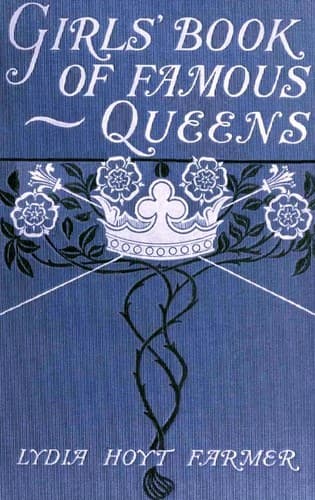
The Girls' Book of Famous QueensFarmer, Lydia Hoyt
History
The Girls' Book of Famous Queens
Farmer, Lydia Hoyt
Queens -- Biography -- Juvenile literature
The very element in his nature which made him transcendent for good,
rendered him also powerful for evil, when his resolution had once
been taken in a wrong direction. His unconquerable will, which bore
him upward through the most overwhelming difficulties, and crowned
him with well-merited success, when his aspirations were inspired by
true patriotism and the laudable desire to benefit his country,—that
same unconquerable will became his bane, and led him into the most
lamentable errors when his former high aspirations had been supplanted
by personal ambition and inordinate desire for power.
We cannot give a consecutive history of Napoleon’s errors and downfall
in this sketch, but they will appear from time to time, as we trace a
short outline of the life of Josephine. We do not pretend to say that
Josephine always consciously guided Napoleon’s career and moulded the
events of his life. His own genius raised him to his exalted position,
we admit; but we do contend that with Josephine he prospered, and
without her he fell.
And according to many authorities, it was Josephine’s bridal gift to
him that gave him the command of the army of Italy; for it was Barras
who recommended Bonaparte to the convention; and it was Barras who
assured Madame de Beauharnais that if she married General Bonaparte he
would contrive to have him appointed to that command.
We have space but to give two scenes in the life of Josephine before
she became Madame Bonaparte. The former occurred upon the island of
Martinique, when Josephine was a young girl; the latter, after she had
become Vicomtesse de Beauharnais.
One day, when Josephine was about fifteen years of age, she was walking
through the spacious grounds of her uncle’s West Indian plantation, in
the island of Martinique, when she observed a number of negro girls
gathered around an old woman who was engaged in telling their fortunes.
Josephine, with girlish curiosity, drew near; whereupon, the old sibyl
seized her hand, and, reading the lines there, appeared to be greatly
moved.
“What do you see?” inquired Josephine.
“You will not believe me if I speak,” answered the fortune-teller.
“Speak on, good mother,” said Josephine; “what have I to fear or hope?”
“On your own head be it then; listen,” said the old sibyl.
“You will be married soon; that union will not be happy; you will
become a widow, and then,—you will be queen of France! Some happy years
will be yours; but you will die in a hospital, amid civil commotion;”
after saying which, the old woman speedily disappeared.
Josephine thought little of this matter at the time, and only laughed
about it with her friends; and when she was residing at Navarre, after
the divorce, she thus commented upon it:—
Public-domain text, read in full here on John Shaqi.
Reviews
Reviews
No reviews yet
Be the first to share your thoughts on this work.
Elsewhere in the archive
Join the Discussion
Join the discussion
Sign in to leave a comment or review.
Sign InorCreate an account