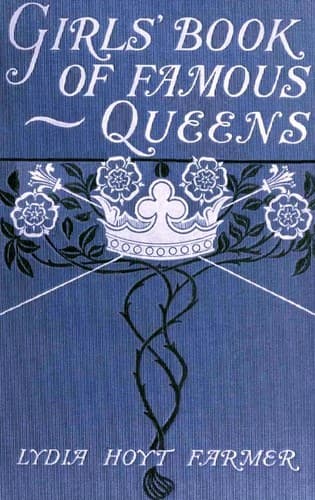
The Girls' Book of Famous QueensFarmer, Lydia Hoyt
History
The Girls' Book of Famous Queens
Farmer, Lydia Hoyt
Queens -- Biography -- Juvenile literature
“And so her Majesty beseeches that I be dismissed! We’ll see, my lady,
whether you or I shall conquer in this contest! You think you hold your
husband’s heart; but I hold the ear of his proud ambition. Which, think
you, will prevail? You are surrounded by his relations, who hate you
with envious and jealous hatred, than which there is none more bitter.
I am their confidant. Ha! methinks my cards in hand shall win the game,
even against the _Queen of Hearts_!”
Bourrienne relates the following conversation with Fouché, which bears
upon this point:—
“I said a few words to him about Bonaparte’s regret at not having
children. My object was to learn Fouché’s opinion on this subject;
and it was not without a feeling of indignation I heard him say, ‘It
is to be hoped the empress will soon die. Her death will remove many
difficulties. Sooner or later he must take a wife who will bear him
a child; for as long as he has no direct heir, there is every chance
that his death will be the signal for a revolution. His brothers are
perfectly incapable of filling his place, and a new party would rise up
in favor of the Bourbons, which must be prevented above all things.’”
And yet this same Fouché afterwards intrigued for the return of the
Bourbons.
Just before Napoleon signed his second abdication, a provisional
government was established with Fouché at the head. This crafty
schemer was at that time the agent of Louis XVIII. and of the Duke of
Wellington; and so it was Fouché, who, as a leader in the Chamber of
Deputies, forced Napoleon to sign the second abdication. The Marquis de
Bonnay wrote concerning his intrigues:—
“I know for a certainty that M. de M., who was sent to Vienna by
Fouché, has taken part in a dialogue to the following effect:—
“‘Do not go to war with us, and we will rid you of that man.’
“‘Well, then; rid us of him at once.’
“‘Would you like the king of Rome, or a regency?’
“‘No!’
“‘The Duke of Orleans?’
“‘No!’
“‘Well, Louis XVIII.?—since it must be so. But no nobility, no
priestcraft, and above all, no Blacas.’
“‘Begin by ridding us of Bonaparte and all his race.’”
And rid them of Bonaparte, Fouché did; and again this wily diplomat,
or base traitor,—according as the reader sides with one or the other
party,—came once more to the front, and received again the office of
minister of police under Louis XVIII. Thus Fouché had played his cards
and won, and Josephine and Napoleon had lost. Surely the title which
Lanfrey applies to Napoleon would most fittingly describe Fouché,—“_an
incorrigible gambler_.”
Public-domain text, read in full here on John Shaqi.
Reviews
Reviews
No reviews yet
Be the first to share your thoughts on this work.
Elsewhere in the archive
Join the Discussion
Join the discussion
Sign in to leave a comment or review.
Sign InorCreate an account