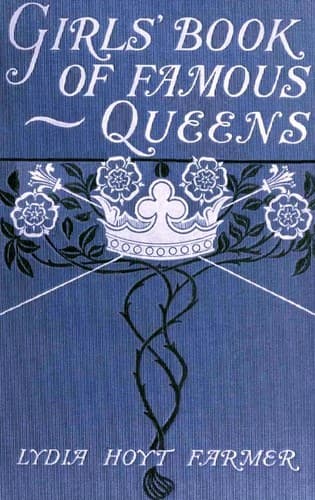
The Girls' Book of Famous QueensFarmer, Lydia Hoyt
History
The Girls' Book of Famous Queens
Farmer, Lydia Hoyt
Queens -- Biography -- Juvenile literature
When Joseph Bonaparte became king of Naples, his sister Caroline,
then Grand Duchess of Berg, avoided as much as possible her modest
sister-in-law, the queen of Naples. But finding herself obliged to
give her the title of “Your Majesty,” she dared at length to complain
to Napoleon that he had not yet given her a crown. Napoleon replied:
“Your complaint astonishes me, madame! To hear you, one might suppose
I had deprived you of your right of succession to the throne of your
_ancestor_.”
No one of Napoleon’s evil advisers was more crafty, insidious, and
unscrupulous than Fouché. Like a Mephistopheles, with sardonic smile he
held his fingers on the keys which played the tune of politics. Through
his minions, the police, he entered even the closed doors of his
Majesty’s cabinet, and caught the rumors which dropped in idle gossip
from the rosy lips of the beauties of the court.
After his cool affront to Josephine, in endeavoring to persuade her
that she should herself suggest to Napoleon the divorce, she begged the
emperor to remove Fouché from his office of minister of police; but
Bonaparte, with strange blindness, kept the wily serpent near him, and
banished from his presence his own guardian angel. And when at last he
had been stung himself by the treacherous fangs of the insidious viper,
and Napoleon became at length convinced that Fouché was maintaining a
correspondence with England, through his spies, the emperor dismissed
him; but it was too late.
The same Fouché who had thrust the dagger into the heart of Josephine,
afterwards proved to be one of the chief instigators of the plots which
caused the second abdication of Napoleon. Bourrienne thus pithily
describes him:—
“Fouché had opinions, but he belonged to no party; and his political
success is explained by the readiness with which he always served
the party he knew must triumph, and which he himself overthrew in
its turn. He maintained himself in favor, from the days of blood and
terror until the time of the second restoration, only by abandoning and
sacrificing those who were attached to him. In all things he looked
only to himself; and to this egotism he sacrificed both subjects and
governments.
“Such were the secret causes of the sway exercised by Fouché during
the Convention, the Directory, the Empire, and after the return of
the Bourbons. He helped to found and to destroy every one of these
successive governments.”
Napoleon afterwards realized some of the treachery of this archtraitor,
and thus spoke of him at St. Helena:—
“Fouché is a miscreant of all colors;—a priest, a Terrorist, and one
who took an active part in many bloody scenes of the Revolution. He is
a man who can worm all your secrets out of you with an air of calmness
and of unconcern.”
What wonder that poor unsuspicious Josephine was betrayed by such a
Judas!
This smiling Mephistopheles might thus have counselled with his crafty
soul:—
Public-domain text, read in full here on John Shaqi.
Reviews
Reviews
No reviews yet
Be the first to share your thoughts on this work.
Elsewhere in the archive
Join the Discussion
Join the discussion
Sign in to leave a comment or review.
Sign InorCreate an account