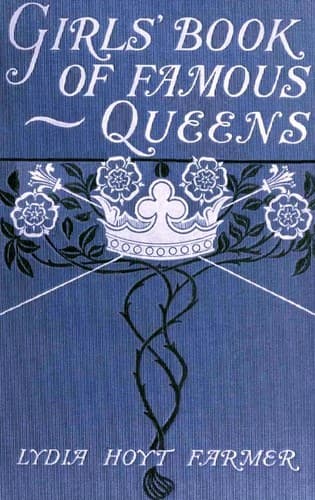
The Girls' Book of Famous QueensFarmer, Lydia Hoyt
History
The Girls' Book of Famous Queens
Farmer, Lydia Hoyt
Queens -- Biography -- Juvenile literature
“As the sad scene which had revealed the domestic trouble in the
imperial family was soon publicly known, the divorce became the subject
of conversation at the court and throughout the nation. The unfortunate
Josephine was supported, it is true, by the affection of her children,
who felt the blow scarcely less keenly than herself; but being
convinced of the absolute futility of resistance, she had, after the
deepest anguish, submitted, rather than resigned herself to that strong
will which henceforward became inflexible.
“In order to feign consent, it was necessary that she should show
herself in public. Hence she was dragged about to all the grand
official receptions, and the scandal-loving public watched her closely,
in order to note the extent and progress of her misfortune. The echoes
of the palace more than once repeated her sobs and complaints; but
it was desirable that this victim of pride and policy should appear
content to sacrifice herself, and she was not allowed the satisfaction
even of a display of grief. In the _fêtes_ given at the commencement
of December, to celebrate the anniversary of the coronation, Paris
beheld her, with death in her heart and a smile on her lips, bearing
the despair which was a torture to her, with grace playing her part
of sovereign for the last time; surrounded by her children, who, to
use the expression of a contemporary, were dancing at their mother’s
funeral.”
Upon his arrival in Paris, after the blow had fallen upon poor
Josephine, Prince Eugène had a mournful interview with his afflicted
mother.
“’Tis not,” said that noble woman in the agony of her heart, “’tis not
that I regret the throne, my son, but I feel that I am leaving the
emperor a prey to the evil-minded men who seek his ruin. I shall be no
longer here to warn him against their false-hearted counsels. The task
reserved for me henceforth will be to pity him, and to pray for him and
the French people whom I love. _My children will imitate my example._”
Bourrienne gives the following words of Josephine, regarding her
divorce:—
“I was ushered into the drawing-room at Malmaison, where I found
Josephine and Hortense. When I entered, Josephine stretched out her
hand to me, saying, ‘Ah, my friend!’ These words she pronounced with
deep emotion, and tears prevented her from continuing. She threw
herself on the ottoman on the left of the fireplace, and beckoned me to
sit down beside her. Hortense stood by the fireplace, endeavoring to
conceal her tears. After a struggle to overcome her feelings, Josephine
said:—
“‘I have drained my cup of misery. He has cast me off!—forsaken me! He
conferred upon me the vain title of empress only to render my fall the
more marked. Ah! I knew the destiny that awaited me; for what would
he not sacrifice to his ambition!’ As she finished these words, one
of Queen Hortense’s ladies entered with a message to her; Hortense
withdrew, so that I was left alone with Josephine.
Public-domain text, read in full here on John Shaqi.
Reviews
Reviews
No reviews yet
Be the first to share your thoughts on this work.
Elsewhere in the archive
Join the Discussion
Join the discussion
Sign in to leave a comment or review.
Sign InorCreate an account