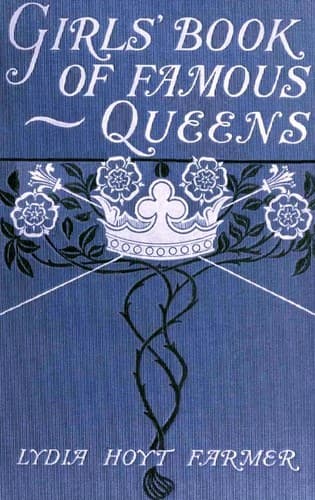
The Girls' Book of Famous QueensFarmer, Lydia Hoyt
History
The Girls' Book of Famous Queens
Farmer, Lydia Hoyt
Queens -- Biography -- Juvenile literature
“The Nelumbo was cultivated as much for its usefulness as an article
of food, as for its beauty. Its roots, seeds, and leaf-stalks are all
edible. The fruit is formed of many valves, each containing a nut
about the size of a filbert, with a taste more delicate than that of
almonds. The use of the seeds in making bread, and the mode of sowing
them,—by enclosing each seed in a ball of clay, and throwing it into
the water,—may probably be alluded to in the text, ‘Cast thy bread
upon the waters, for thou shalt find it after many days.’ The Nelumbo
is a native of the north of Africa, of India, China, Japan, Persia,
and Asiatic Russia, and in all these countries maintains its sacred
character. The fable of the nymph Lotis, who was transformed into a
tree bearing her name, is supposed to be of Eastern origin. It was
under the lote-tree, beyond which there is no passing, that Mohammed
was said to have met the angel Gabriel. This lotis or lotus tree must
not be confounded with the sacred bean, or lotus flower, which is a
totally distinct plant. The lotus-tree is a moderate-sized thorny tree,
with broad leaves, fruit as large as an olive, of a reddish color,
containing the nut, the taste of which is sweetish, resembling that of
a fig or date. It was this lotus-tree which Homer refers to, when he
describes the charm of certain fruit which Ulysses dreaded would lure
his companions to give up home and friends forever, as the fable was,
that whosoever ate of its fruit would never leave the enchanted land.”
On account of these numerous stories connected with the far-famed
lotus of the East, it has become one of the most illustrious flowers
of romance and poetry. Its praises have been sung in all the languages
of Eastern climes, until its very name has become the synonyme for
oriental splendor and goddess-like attractions.
The asp appeared to be one of the favorite emblems of deity, and also
of royalty, and many strange stories are told of different species of
asps. The following is related to show the extreme veneration paid to
sacred animals.
“A sacred serpent of Melite had priests and ministers, a table, and a
bowl. It was kept in a tower, and fed by the priests with cakes made of
flour and of honey, which they placed there in the bowl. Having done
this, they retired. The next day, on returning to the apartment, the
food was found to be eaten, and the same quantity was again put into
the bowl, for it was not lawful for any one to see the sacred reptile.
On one occasion, one of the priests being anxious to behold it, went in
alone, and having deposited the cake, withdrew, until the moment when
he supposed the serpent had come forth to its repast. He then entered,
throwing open the door with great violence, upon which the serpent
withdrew in evident indignation, and the priest shortly after became
frantic, and having confessed his crime, expired.”
Public-domain text, read in full here on John Shaqi.
Reviews
Reviews
No reviews yet
Be the first to share your thoughts on this work.
Join the Discussion
Join the discussion
Sign in to leave a comment or review.
Sign InorCreate an account