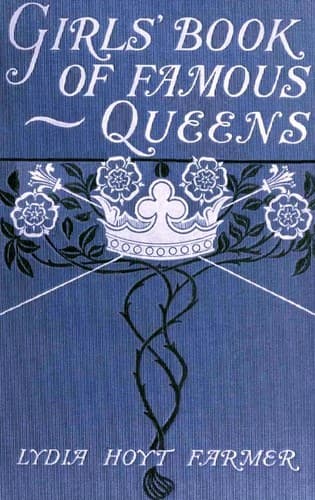
The Girls' Book of Famous QueensFarmer, Lydia Hoyt
History
The Girls' Book of Famous Queens
Farmer, Lydia Hoyt
Queens -- Biography -- Juvenile literature
The partisans of the House of York chose the white rose for their
badge, while the reigning House of Lancaster wore, as their emblem, the
red rose.
Previously to this period, Henry, the king of England, had wedded
Margaret of Anjou.
This princess was the youngest daughter of René, Duke of Anjou. Her
father was the son of Louis II., king of Naples, Sicily, and Jerusalem,
and also sovereign count of Provence, Anjou, and Maine.
But though Duke René was heir to so many kingdoms at the time of his
daughter’s marriage, he was owner of none; and instead of providing her
with a rich dower, suitable to her rank, the marriage stipulations were
very peculiar.
Henry VI. of England was twenty-six years of age. His country was
impoverished by a thirty years’ war. Margaret was at this time living
at Naples, of which realm her father called himself king. Amongst the
princesses selected for the approval of the bachelor king of England,
none pleased King Henry so well as the beautiful face of Margaret of
Anjou, whose portrait had been sent to him for his examination. So
overtures were at once made to the father of this lovely princess.
René consented most readily to the marriage, on the condition that
the bride’s wedding portion should be only her own lovely charms and
superior accomplishments, which he declared were worth more than all
the riches of the world.
But this was not all in this strange marriage agreement. René also
demanded that Henry should restore to him his patrimonial estates of
Anjou and Maine, which had been wrested from him.
Though Margaret’s father possessed so many high-sounding titles, he
was in truth a royal pauper. He had been driven out of Naples, England
held Anjou and Maine, and in order to pay his ransom to the Duke of
Burgundy, who had kept him a prisoner for six years, René had been
obliged to mortgage his other dominions, so that now he possessed
neither castle nor an acre of ground he could call his own.
The Earl of Suffolk, who had been sent by King Henry to make the
marriage settlements, was alarmed to bring back to his sovereign such
an unheard-of demand from the father of a portionless bride; but as
René would not relent, Suffolk was forced to return to his king with
this strange proposal.
Although King Henry was almost as much poverty-stricken as the lovely
princess, her fair face so bewitched him that he readily consented to
take her, not only without dower, but to relinquish for her the domains
of Anjou and Maine.
The Earl of Suffolk was sent back to wed the fair princess as proxy
for Henry, and in St. Martin’s church, at Nanci, in November, 1444,
Margaret was married by proxy, the bride being in her fifteenth year.
The ceremony was performed in the presence of her aunt, Marie of Anjou,
queen of France, and Charles VII. The bride’s father and mother were
also present, and all the leading nobles of the courts of France and
Lorraine; the mother of the bride being Isabella, claimant of the duchy
of Lorraine.
Public-domain text, read in full here on John Shaqi.
Reviews
Reviews
No reviews yet
Be the first to share your thoughts on this work.
Elsewhere in the archive
Join the Discussion
Join the discussion
Sign in to leave a comment or review.
Sign InorCreate an account