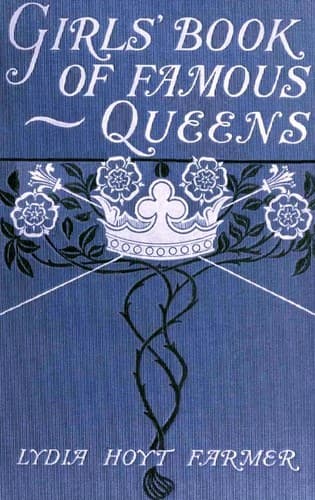
The Girls' Book of Famous QueensFarmer, Lydia Hoyt
History
The Girls' Book of Famous Queens
Farmer, Lydia Hoyt
Queens -- Biography -- Juvenile literature
Matilda’s last years were embittered by domestic troubles. She
remained in Normandy. The death of her daughter Constance and renewed
quarrels between Robert and his father, added to her own failing
health, quickened her decline. She died at Caen, in November, 1083. Her
husband hastened from England when informed of her danger, and arrived
as she breathed her last. She was interred in the Church of the Holy
Trinity at Caen. William the Conqueror survived her only four years,
when his death was occasioned by an accident during the storming of the
city of Nantes, when his horse stumbled over some burning timber, and
throwing the king violently forward in the saddle, he was so seriously
injured as to result in his death. William the Conqueror was buried in
the Church of St. Stephen at Caen. The portraits of William and Matilda
were painted upon the walls of St. Stephen’s chapel.
William was remarkable for his great strength and imposing beauty. He
was a head taller than all his subjects. The face of Queen Matilda
was beautiful and delicate. Their two sons, William Rufus and Henry,
reigned successively over England. Robert died in prison. Their fourth
daughter, Adela, was the mother of King Stephen.
In 1562 the Calvinist soldiers broke open the tombs of William and
Matilda, hoping to find rich treasures; but finding nothing but a
sapphire ring upon Matilda’s finger, they rudely threw the bones
carelessly around. In 1642 these relics were collected, and their
tombs restored, though at the close of the last century the French
Republicans destroyed the monumental memorial of Matilda, which
had been there erected by her husband before his death. Thus the
needle-work of Queen Matilda has proved to be a more lasting memorial
of her fame than the costly monument of marble erected to her memory.
MARGARET OF ANJOU.
A.D. 1429-1482.
“The red rose and the white are on his face,
The fatal colours of our striving houses.”
—SHAKESPEARE.
ONE of the most momentous civil commotions in the annals of English
history was the famous War of the Roses, which was waged for many
years between the Houses of Lancaster and York, during which sanguine
contests the plains of England were deluged with blood; eighty princes
were slain, and the ancient nobility were almost entirely annihilated.
With these exciting incidents the name of Margaret of Anjou is
indissolubly associated, and she stands forth in history as one of the
most important participants in that great civil struggle, which may be
thus briefly stated.
Henry VI., the reigning king of England, was the son of John of Gaunt,
a younger son of Edward the Third. About this time, the Duke of York,
who was descended by his mother’s side from Lionel, an older son of the
same Edward, aspired to the throne, and gathering to his standard many
powerful nobles, he sought to dethrone King Henry.
Public-domain text, read in full here on John Shaqi.
Reviews
Reviews
No reviews yet
Be the first to share your thoughts on this work.
Elsewhere in the archive
Join the Discussion
Join the discussion
Sign in to leave a comment or review.
Sign InorCreate an account