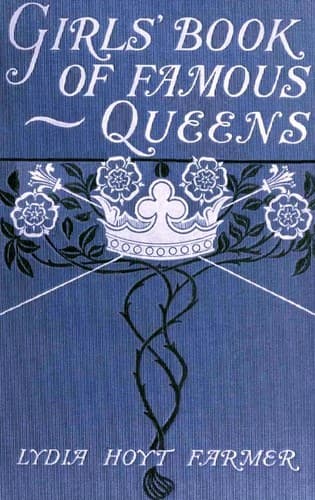
The Girls' Book of Famous QueensFarmer, Lydia Hoyt
History
The Girls' Book of Famous Queens
Farmer, Lydia Hoyt
Queens -- Biography -- Juvenile literature
This action procured for her the name of _Dido_, a “heroine” or
“valiant woman,” her previous name having been Elissa; though some
authorities declare that _Dido_ neither denotes the “heroine,” as
Servius maintains; nor the “man-slayer,” as Eustathius pretends; nor
the “wanderer,” as other writers claim; but the name _Dido_ means
nothing more than “the beloved,” whether the reference be to Baal or
to her husband. The other appellation, Elissa, is said to mean “the
exulting,” or “joyous one,” though Bochart claims that it signifies
“the divine maiden.”
Her subjects after her death paid her divine honors.
Thus authorities differ as much over Dido’s name as accounts differ
regarding her life. Virgil’s poetical version of the story deviates
quite materially from the historical narrative of Justin; but as
Virgil’s famous poem of the Æneid has obtained such world-wide fame,
and gained a lasting place in classic literature, his story of Dido is
too important to pass by unnoticed, and may be thus briefly narrated.
According to Virgil’s account, Dido flourished about the time of the
Trojan War, whereas historians place her 247 years later in history, or
about 937 B.C.
Dunlop, in his History of Roman Literature, says: “Virgil wrote at
such a distance of time from the events which formed the groundwork
of his poem, and the events themselves were so obscure, that he could
depart from history without violating probability. Thus it appears
from chronology that Dido lived nearly three hundred years after the
Trojan War; but the point was one of obscure antiquity, known perhaps
to few readers, and not very precisely ascertained. Hence, so far was
the violence offered to chronology from revolting his countrymen, that
Ovid, who was so knowing in ancient histories and fables, wrote an
heroic epistle as addressed by Dido to Æneas.”
The reason of Dido’s death is also differently stated by Virgil. But,
notwithstanding these great and unreconcilable discrepancies, no one
can fail to enjoy the charming story of Dido as related by the gifted
poet.
[Illustration: HELEN OF TROY
_Lord Leighton_
By permission of Henry Graves & Co., Ltd., proprietors of the
copyright.]
Public-domain text, read in full here on John Shaqi.
Reviews
Reviews
No reviews yet
Be the first to share your thoughts on this work.
Join the Discussion
Join the discussion
Sign in to leave a comment or review.
Sign InorCreate an account