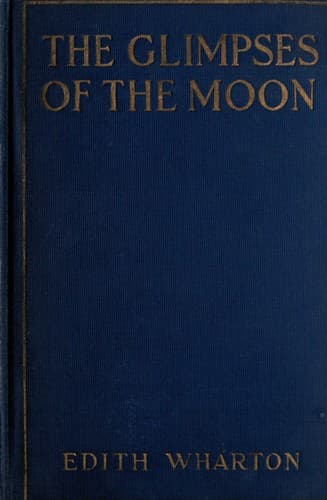
Americans -- Europe -- Fiction; Europe -- Fiction; Love stories; Marriage -- Fiction; Married people -- Fiction; Socialites -- Fiction
If of late he had tried to look into the future more insistently than
was his habit, it was only because of Susy. He had meant, when they
married, to be as philosophic for her as for himself; and he knew she
would have resented above everything his regarding their partnership as
a reason for anxious thought. But since they had been together she had
given him glimpses of her past that made him angrily long to shelter
and defend her future. It was intolerable that a spirit as fine as hers
should be ever so little dulled or diminished by the kind of compromises
out of which their wretched lives were made. For himself, he didn’t care
a hang: he had composed for his own guidance a rough-and-ready code,
a short set of “mays” and “mustn’ts” which immensely simplified his
course. There were things a fellow put up with for the sake of certain
definite and otherwise unattainable advantages; there were other things
he wouldn’t traffic with at any price. But for a woman, he began to
see, it might be different. The temptations might be greater, the cost
considerably higher, the dividing line between the “mays” and “mustn’ts”
more fluctuating and less sharply drawn. Susy, thrown on the world
at seventeen, with only a weak wastrel of a father to define that
treacherous line for her, and with every circumstance soliciting her to
overstep it, seemed to have been preserved chiefly by an innate scorn
of most of the objects of human folly. “Such trash as he went to pieces
for,” was her curt comment on her parent’s premature demise: as
though she accepted in advance the necessity of ruining one’s self for
something, but was resolved to discriminate firmly between what was
worth it and what wasn’t.
This philosophy had at first enchanted Lansing; but now it began to
rouse vague fears. The fine armour of her fastidiousness had preserved
her from the kind of risks she had hitherto been exposed to; but what if
others, more subtle, found a joint in it? Was there, among her delicate
discriminations, any equivalent to his own rules? Might not her taste
for the best and rarest be the very instrument of her undoing; and if
something that wasn’t “trash” came her way, would she hesitate a second
to go to pieces for it?
He was determined to stick to the compact that they should do nothing to
interfere with what each referred to as the other’s “chance”; but what
if, when hers came, he couldn’t agree with her in recognizing it? He
wanted for her, oh, so passionately, the best; but his conception of
that best had so insensibly, so subtly been transformed in the light of
their first month together!
Public-domain text, read in full here on John Shaqi.
Reviews
Reviews
No reviews yet
Be the first to share your thoughts on this work.
Join the Discussion
Join the discussion
Sign in to leave a comment or review.
Sign InorCreate an account