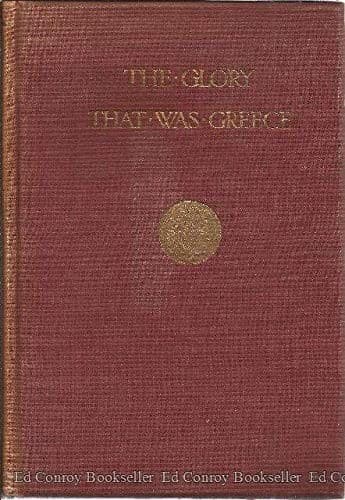
The Glory That Was Greece: a survey of Hellenic culture and civilisationStobart, J. C. (John Clarke)
History
The Glory That Was Greece: a survey of Hellenic culture and civilisation
Stobart, J. C. (John Clarke)
Art, Greek; Greece -- Civilization -- To 146 B.C.
In the great oration over the bodies of the dead Athenian soldiers which
Thucydides ascribes to Pericles the statesman is made to express his
ideal of Athens. She was “the instructress of Greece.” She alone, he
said, followed “culture without extravagance, and philosophy without
softness.” She alone combined daring with reflection. She alone welcomed
strangers, and, while reverencing the gods and the laws, permitted
freedom of speech and conscience to all men. He congratulated her upon
the happiness of life at Athens, the public displays and sacrificial
banquets which afforded daily delight to her inhabitants. He did not lay
much stress upon the outward magnificence of the city, for that, in a
large measure, was his own work. But it is that aspect of his policy
which we can all appreciate, whether we are democrats or imperialists or
neither or both.
Pericles himself set the example which Athens followed of encouraging
talent from all quarters to devote its abilities to the service of
Athens. Aspasia seems to have maintained a salon which was frequented by
most of the men of genius of the day. She herself was of Miletus, and
being an Ionian, was accustomed to a freedom of intellectual intercourse
denied to the cloistered women of Attica. Pericles had separated by
mutual consent from his wife, and though the laws did not allow him to
marry a foreigner, he lived with Aspasia through most of his public
career. She was a wit as well as a beauty. At her house you would meet
Pheidias the sculptor, Damon the musician, Anaxagoras the philosopher,
Alcibiades, and Socrates. There, we may presume, the plans for the
beautification of Athens were freely discussed.
It was a rare opportunity for the artists. Here was an imperial city to
be rebuilt, and plenty of money to build with.
[Illustration: PLATE XL. SCULPTURES OF THE EASTERN PEDIMENT OF THE
PARTHENON
_Mansell & Co._]
The directors of the work were Pheidias the sculptor and Ictinus the
architect. Pheidias had learnt his craft under Agelâdas of Argos. Thus
he stands at the very beginning of the period of fine art. Technical
mastery over stone and bronze was by no means complete when he began to
work. The “archaic smile” still hovered over the lips of contemporary
sculptures, the eyes were too prominent, the eyelids were still cut to
meet at the corners instead of overlapping, hair was still
conventionally rendered by parallel grooves, or spirals, or roughly
blocked out for coloration.
Public-domain text, read in full here on John Shaqi.
Reviews
Reviews
No reviews yet
Be the first to share your thoughts on this work.
Elsewhere in the archive
Join the Discussion
Join the discussion
Sign in to leave a comment or review.
Sign InorCreate an account