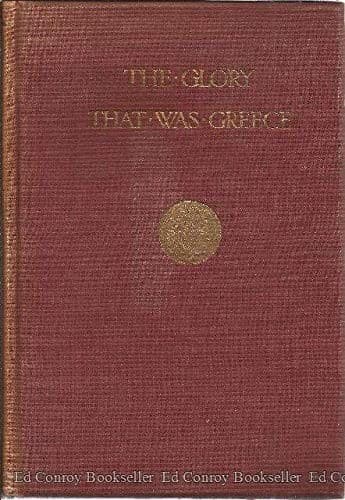
The Glory That Was Greece: a survey of Hellenic culture and civilisationStobart, J. C. (John Clarke)
History
The Glory That Was Greece: a survey of Hellenic culture and civilisation
Stobart, J. C. (John Clarke)
Art, Greek; Greece -- Civilization -- To 146 B.C.
We find another example of the versatile genius of Ictinus at Eleusis.
Eleusis was the most important town of Attica except Athens, and had
long been independent. It formed an agricultural centre for the plain
around it. Its famous mysteries were of agricultural significance to
start with, and were chiefly concerned with the worship of Demeter and
Persephone in their characters as grain-givers. It was no doubt a later
development when the Greeks began to graft the deepest religious and
metaphysical doctrines relating to immortality upon them. We can easily
see how rustic rites celebrating the death and rebirth of the cornfields
should come to bear this exalted meaning for reflective people. Every
year on the fifth night of the Greater Eleusinian festival in spring the
Athenian people trooped out along the Sacred Way in a torchlight
procession. Only the initiated, the Mystæ, were allowed to witness the
secret ceremony, which seems to have consisted of a ritual marriage. For
most illuminating suggestions as to its real nature I would refer the
reader to Mr. J. C. Lawson’s recent book on “Modern Greek Folklore and
Ancient Greek Religion.”
The Great Temple of the Mysteries was designed, but not completed, by
Ictinus, for the Peloponnesian War put a stop to the Eleusinian
worshippers from Athens--not the least of their deprivations. But they
were resumed when Alcibiades came home, and continued until Alaric the
Goth destroyed the temple. The peculiarity of this building is that it
cuts into the living rock. The interior somewhat resembled a theatre,
with eight stone tiers all round it, and an upper story supported on
columns. The building itself was square, with a portico in
[Illustration: PLATE LI. THE “AGIAS” OF LYSIPPUS
_English Photo Co., Athens_]
front only. The upper story was reached by a rock-terrace cut out of the
hill-side at the back. The whole temple, with out-buildings, was
enclosed by a wall.
Summing up the architectural character of the period, we should say that
it was severely limited by the conservatism of religion to the austerest
outlines and the simplest plans. Such laws it loyally obeyed, and yet
found scope for exquisite workmanship and subtle varieties within them.
Ictinus and Mnesicles were quite capable of adapting themselves to any
local peculiarities, but the strict Doric style still reigned supreme.
Finally we note that fine architecture is almost entirely confined to
the service of religion and patriotism, while private and secular
buildings are still on the most unpretentious scale. The only
architectural work of a strictly utilitarian character that we can
mention is the planning of the Peiræus, which was as orderly, as regular
and as dull as “town-planned” towns generally are.
TRAGEDY AND COMEDY
Public-domain text, read in full here on John Shaqi.
Reviews
Reviews
No reviews yet
Be the first to share your thoughts on this work.
Elsewhere in the archive
Join the Discussion
Join the discussion
Sign in to leave a comment or review.
Sign InorCreate an account