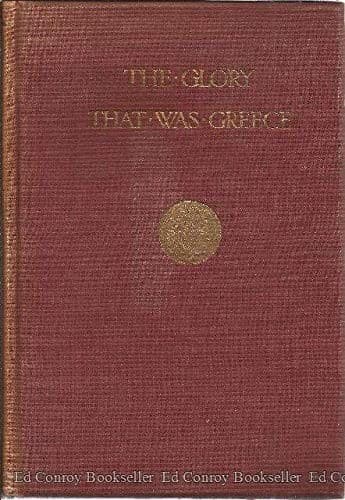
The Glory That Was Greece: a survey of Hellenic culture and civilisationStobart, J. C. (John Clarke)
History
The Glory That Was Greece: a survey of Hellenic culture and civilisation
Stobart, J. C. (John Clarke)
Art, Greek; Greece -- Civilization -- To 146 B.C.
Turning now to philosophy, we are confronted at once with the problem of
Socrates and his real personality.[106] The sage himself wrote nothing,
but he has been written of by two immediate disciples, Xenophon and
Plato. Between the two we must form our idea of the man. It is likely
that Xenophon missed a great deal of the inner meaning of his master’s
teaching, but it is certain that Plato used Socrates as a peg for his
own ideas with a freedom which could only be tolerated in a country
where portraiture was seldom as yet practised as an art. Socrates may be
shortly described as a man who went about asking “Why?” It is a habit
that we are too apt to repress in children: the Athenians put Socrates
to death for it. Remember that it was the age when sophistry--that is,
formal profession of superior wisdom--was beginning to be rife, when
professors of this, that, and the other were abroad in the streets of
Athens. You may reduce any professor to tears by asking him “Why?” with
sufficient persistence, especially if you are followed by a train of
admiring young men of good family. Socrates was very pertinacious and
absolutely fearless. So a jury of Athenian citizens condemned him to
drink hemlock on the charge of corrupting the youth with atheistical
doctrines. He was certainly not an atheist. He was deeply religious in
the highest sense. He objected, or at least Plato did, to the theology
of Homer as undignified, in that it exhibited gods laughing and weeping.
But he used constantly to speak of “the God,” “the divine principle,”
and even of a “Daimonion,” or divine spirit in his own breast. Moreover,
Apollo, speaking by the mouth of the Delphic oracle, had declared him to
be the wisest of mankind.
In the main, there is no doubt but that the condemnation of Socrates
was, like that of Christ, a political move. Both Critias and Theramenes,
the foremost leaders of the oligarchic revolution, were among the
disciples of Socrates. Both Anytus and Melitus, his accusers, belonged
to the democratic reactionaries who had overthrown them. If we may judge
by Plato and Xenophon, Socrates was unquestionably a keen critic of the
innumerable sophistries upon which democracy was built. With all that,
Socrates was a good citizen and patriot. He had fought in many Athenian
battles, the soldiers marvelled at his contempt for cold and danger, he
had done his best to prevent the unjust sentence upon the generals of
Arginusæ, he had incurred the hostility of the Thirty Tyrants.
Public-domain text, read in full here on John Shaqi.
Reviews
Reviews
No reviews yet
Be the first to share your thoughts on this work.
Elsewhere in the archive
Join the Discussion
Join the discussion
Sign in to leave a comment or review.
Sign InorCreate an account