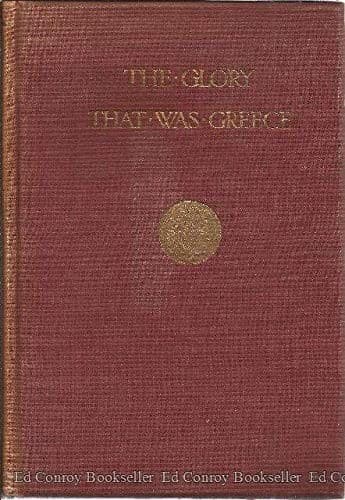
The Glory That Was Greece: a survey of Hellenic culture and civilisationStobart, J. C. (John Clarke)
History
The Glory That Was Greece: a survey of Hellenic culture and civilisation
Stobart, J. C. (John Clarke)
Art, Greek; Greece -- Civilization -- To 146 B.C.
“‘Bury me any way you like,’ answered Socrates, ‘if you get hold of
me and I don’t escape you.’ He looked at us with a quiet smile and
proceeded: ‘No, sirs, I can’t convince Crito that I am this
Socrates who is now conversing with you. He thinks I am that one
whom he will presently see dead, and he asks, if you please, how he
is to bury me. I have been making a long speech to prove that when
I have drunk the poison I shall not be with you any more, but shall
have gone away to enjoy whatever blessings await the departed; only
I am afraid it is all lost upon Crito, with all my consolations for
myself and you. So you must be my sureties with Crito in a pledge
just contrary to that which he gave to my judges. He went bail that
I would remain here. You must go bail that I shall certainly not
remain, but abscond and vanish. Then Crito will be less afflicted,
and when he sees my body being burnt or buried he won’t grieve for
me as if something unpleasant was happening to me, and he won’t say
at the funeral that it is Socrates he is laying out or burying.’”
Then the story of his painful and courageous death is told in language
of extraordinary simplicity and dignified restraint. “Such, Echecrates,
was the last end of our companion, as we should say, the best, the
wisest, and the justest man of all we had ever known.”
Socrates had done much towards giving Greek philosophy its new trend.
The earlier philosophers had been chiefly concerned with the physical
universe, trying to discover its origin, and thereby its “principle”;
this had been apt to degenerate into that paltry inquisitiveness about
mere phenomena which many people are still apt to dignify with the name
of “natural science.” Socrates sought not so much the origin as the end
of things; he made philosophy concern herself with the nature of
reality, and incidentally with ethics and conduct.
The development of ideal philosophy may probably be ascribed, in the
main, to Plato rather than Socrates. Perhaps the general English reader
will find the simplest exposition of the Platonic theory of Ideas in
Wordsworth’s “Ode on Intimations of Immortality.” Put very briefly, it
is that the material world apprehended by the human senses is only a
copy or pale reflection of the realities “laid up in heaven.” The soul
comes into this world
“Not in entire forgetfulness
And not in utter nakedness.”
We recognise the forms of things by their likeness to the patterns
apprehended by the soul elsewhere. Thus, as Plato says in the “Meno,”
all learning is a process of recollection. The words of St. Paul to the
Corinthians are almost a verbal echo of this teaching of Socrates: “For
now we see in a mirror darkly, but then face to face: now I know in
part; but then shall I know even as I am known.”
Public-domain text, read in full here on John Shaqi.
Reviews
Reviews
No reviews yet
Be the first to share your thoughts on this work.
Elsewhere in the archive
Join the Discussion
Join the discussion
Sign in to leave a comment or review.
Sign InorCreate an account