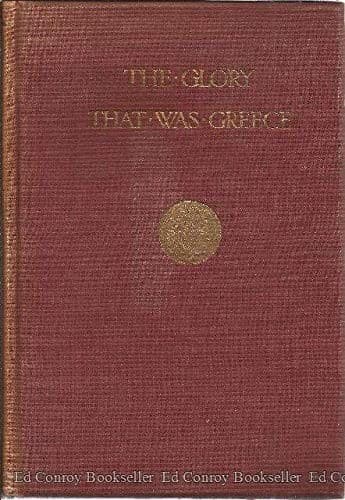
The Glory That Was Greece: a survey of Hellenic culture and civilisationStobart, J. C. (John Clarke)
History
The Glory That Was Greece: a survey of Hellenic culture and civilisation
Stobart, J. C. (John Clarke)
Art, Greek; Greece -- Civilization -- To 146 B.C.
Alexander was worshipped even in his lifetime as a god. He claimed,
among other divine claims, to be a son of Ammon. In this character he is
represented with the ram’s horns of that Egyptian deity on a coin of
Thrace cast by Lysimachus, one of his generals and successors.
[Illustration: Plate 84. PORTION OF THE EASTERN FRIEZE OF THE
SARCOPHAGUS OF ALEXANDER.]
Alexander was the first of mortals to have his portrait on Greek coins,
and it is only in virtue of the divine honours paid to him that this is
conceded even to the conqueror of the world. Many of the later kings
followed his example, and portraiture on the coins now becomes common.
ALEXANDRIA
In studying the early civilisation of Europe, which means the history of
the Mediterranean peninsulas, one must not forget that economically
Egypt is the key to the whole position. In natural resources it is far
the richest country in that region. Hitherto, however, it had been shut
off from the rest of the world by its own peculiar civilisation and
religion, though the Greeks had occasionally borrowed ideas from it and
sometimes interfered in its historical course. Now Alexander gives it a
Greek government and a Greek capital. In order to crush the Phœnician
fleet which had been the principal naval support of the Persian Empire,
he had been compelled to destroy the city of Tyre. But it was more than
a strategic move. He intended the commerce and sea-power of the Levant
to be henceforth in Greek hands. He succeeded brilliantly in his
purpose. Phœnicia passed away from the stage of history, and only
survived in her great colony of Carthage.
The city of Alexandria was laid out on a mathematical plan by Greek
architects. Its situation on the delta of the Nile was exceedingly
favourable to commerce, especially as the difficult navigation of its
waters was mitigated by the construction of a great lighthouse, one of
the Seven Wonders of the World. In the division of the empire Egypt had
the good fortune to fall to the share of Ptolemy, a wise and enlightened
ruler, as were most of his descendants of the same name. These all
pursued a policy of commerce and peaceful expansion. There was brisk
traffic between Alexandria, Rhodes, Pergamum, Athens, and Syracuse, and
Alexandria grew to be the greatest city in the world. It was
pre-eminently Greek, but tinctured also with some of the Orientalism of
its environment.
Public-domain text, read in full here on John Shaqi.
Reviews
Reviews
No reviews yet
Be the first to share your thoughts on this work.
Elsewhere in the archive
Join the Discussion
Join the discussion
Sign in to leave a comment or review.
Sign InorCreate an account