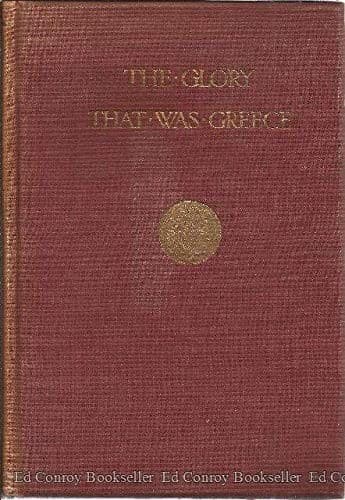
The Glory That Was Greece: a survey of Hellenic culture and civilisationStobart, J. C. (John Clarke)
History
The Glory That Was Greece: a survey of Hellenic culture and civilisation
Stobart, J. C. (John Clarke)
Art, Greek; Greece -- Civilization -- To 146 B.C.
Along with commerce the Ptolemies cultivated literature by founding a
sort of university or college called the Museum. It consisted of a
temple of the Muses, rooms for its members, a common dining-hall,
cloistered walks for the peripatetic teacher, and above all of a
magnificent library, for which the kings of Egypt made it their ambition
to collect all the books in the world. Half a million MSS. were gathered
there in the third century. The chief librarian was the master of the
whole institution, which was a place of research and literary production
rather than of education. At the same time Ptolemy made a point of
attracting all the foremost literary men of the Greek world to his
court. It cannot be denied that the Alexandrian culture was rich and
vigorous. Great strides were made in science and mathematics, new and
promising forms of literature were invented, but at the same time the
sheltered air of the Museum tended to produce, as is inevitably the case
with collegiate institutions, a rather frigid and academic type of work.
At Alexandria, for instance, the first critics arose, and the first
literary scholars, whose task was mainly to elucidate and comment upon
the works of Homer. One of these scholars invented the Greek system of
breathings and accents to help in the recital of verse. The most famous
of all of them was Aristarchus, the Father of Criticism. In science and
mathematics we must mention our old friend Euclid, who reigned in the
hearts of schoolboys until the day before yesterday. Here worked
Archimedes, the great engineer and founder of mechanics, statics, and
dynamics. His researches in these directions remained unequalled until
the seventeenth century _anno Domini_. Wondrous stories are told of his
inventions and of his absent-mindedness. Once as he was entering the
bath the overflowing of the water gave him a valuable scientific hint.
He was so pleased that he forgot to dress, but ran home through the
streets crying, “Heureka! Heureka!” At Alexandria, too, lived
Eratosthenes, who first measured the circumference of the earth and
worked out a system of chronology for history.
[Illustration: PLATE LXXXV. ALEXANDER THE GREAT
_Mansell & Co._]
There were many other historians of lesser repute at the Museum.
Public-domain text, read in full here on John Shaqi.
Reviews
Reviews
No reviews yet
Be the first to share your thoughts on this work.
Elsewhere in the archive
Join the Discussion
Join the discussion
Sign in to leave a comment or review.
Sign InorCreate an account