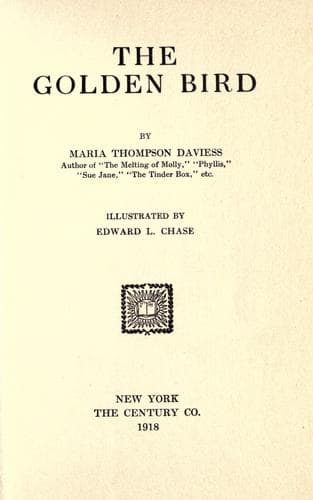
Chickens -- Fiction; Farms -- Fiction; World War, 1914-1918 -- United States -- Fiction
father's sweet old heart there was never an idea of not, as he put it,
"going home." I had never seen Elmnest, but I knew something of the
situation, and that is where the Golden Bird arrived on the situation. The
morning after our decision to return to the land--a decision in which I had
borne no part but a sympathetic one after I had listened half the night to
father's raptures over Uncle Cradd as a Greek scholar with whom one would
wish to spend one's last days--the February copy of "The Woman's Review"
arrived, and on the first page was an article from a woman who earns five
thousand dollars a year with the industrious hen on a little farm of ten
acres. There were lovely pictures of her with her feathered family, and I
decided that what a woman with the limited experience of a head
stenographer in a railroad office could do, I, with my wider scope of
travel and culture, could more than double on three hundred acres of land
in the Harpeth Valley. Some day I'm going to see that woman and I'm going
to stop by and speak sternly to the editor of "The Woman's Review" on my
way.
"Mr. G. Bird," I began as I reached this point and I saw that we were
arriving in the heart of civilization, which was the square of a quaint
little old town. From a motor-car acquaintance, I knew this to be
Riverfield, but I had never even stopped because of the family pride
involved in the feud now dead. "Mr. Bird," I repeated, "I am afraid I am
up against it, and I hope you'll stand by me." He answered me by preening a
breast feather and winking one of his bright eyes as Uncle Cradd stopped
the ancient steeds in the center of the square, before a little old brick
building that bore three signs over its tumble-down porch. They were:
"Silas Beesley, Grocer," "U.S. Post-Office," and "Riverfield Bank and Trust
Co."
"Hey, Si, here's William come home!" called Uncle Cradd, as a negro boy
with a broad grin stood at the heads of the slow old horses, who, I felt
sure, wouldn't have moved except under necessity before the judgment day.
In less time than I can take to tell it father descended literally into the
arms of his friends. About half a dozen old farmers, some in overalls and
some in rusty black broadcloth the color of Uncle Cradd's, poured out of
the wide door of the business building before described, and they acted
very much as I have seen the boys at Yale or Princeton act after a success
or defeat on the foot-ball field. They hugged father and they slapped him
on the back and they shook his hand as if it were not of human,
sixty-year-old flesh and blood. Then they introduced a lot of stalwart
young farmers to him, each of whom gave father hearty greetings, but
refrained from even a glance in my direction as I sat enthroned on high on
the faded old cushions and waited for an introduction, which at last Uncle
Cradd remembered to give me.
Public-domain text, read in full here on John Shaqi.
Reviews
Reviews
No reviews yet
Be the first to share your thoughts on this work.
Join the Discussion
Join the discussion
Sign in to leave a comment or review.
Sign InorCreate an account