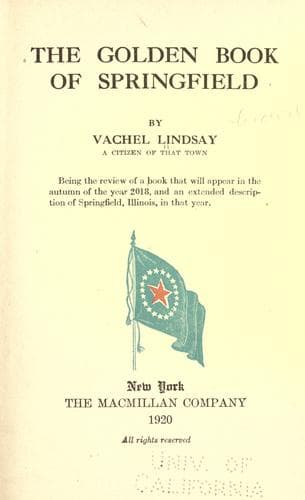
Springfield (Ill.) -- Fiction; Springfield (Ill.) -- In literature; Utopias in literature
The most important revelation to her, sociologically, is that she finds
herself no longer one of “our best people.” That is, she has not much
money, and no privilege of collecting rents in the style that is now the
sole reason many of the “old families” are in Springfield for a part of
the year. She is in Springfield because she loves a certain factory. She
loves it because she is Patricia Anthony, forewoman, and can order
people about. Her factory is at Ninth and Converse Streets, on the same
ground with The Illinois Watch Company and The Sangamon Electric
Company. It is a place where telescopic and microscopic lenses are made.
As for the Golden Book about which she is all aquiver, she finds the
volume when she is inspecting the place in the late afternoon of All
Saint’s Day, Anno Domini, 2018. She says I am there with her, carrying
on, as of old, in the same conceited, philandering way. I am helping
take inventory of the supplies needed for the next week, as my excuse
for the tour. The factory echoes hollow with our solitary steps. Indeed
it takes her aback to meet the book in such an off-hand, teasing moment.
But there is The Golden Book. Every transparent page, which flutters as
though with the gusty thoughts of our spirits, is written in letters of
fire. On the first leaf is an inscription delivering the work to her by
name: “Patricia Anthony.”
She was always a conceited woman, and here is the first thing that ever
happened to her to justify it, I say to her, speaking as one 1920 person
to another.
But on, to 2018: For all the Golden Book is penned so gorgeously, the
discussion is largely economic. There are citations from Adam Smith,
Karl Marx, Henry George, and on, forward, to Joseph Bartholdi Michael
the second, and Black Hawk Boone,—Springfield sages of 2018. All these
are cited to corroborate, in various items, piecemeal, an absolutely new
economic remedy for the world.
Patricia sees herself reading the volume to the workers, through the
lunch hour. The book keeps its wings. Often, as though stirred with
divine impatience, it dashes and flutters on through the walls, as
though they were shadows, then comes soaring back again. Each time it
returns the work is re-opened, at the first page, and newer and more
difficult teaching is written there, till the volume is no longer
economic. It is as though a work by Henry George had been changed into a
work by Swedenborg! Now it shows how to make microscopes that will
enable all Springfield to find the fairies of the fairies, and
telescopes that will discover the angels that guard the angels. At last
the book instructs the devout how to woo and win these creatures,
without turning upon them any glass of cold scrutiny, how to see them
with the natural eye, and touch them with the natural hand.
Public-domain text, read in full here on John Shaqi.
Reviews
Reviews
No reviews yet
Be the first to share your thoughts on this work.
Join the Discussion
Join the discussion
Sign in to leave a comment or review.
Sign InorCreate an account