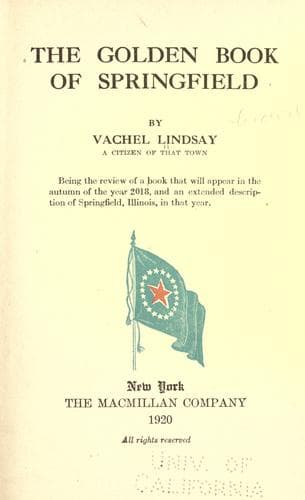
Springfield (Ill.) -- Fiction; Springfield (Ill.) -- In literature; Utopias in literature
According to his tale, we two read it alone of nights. We follow its
counsel as one would secret foot-ball signals. We do not betray the
source of our wisdom to any but Mayor Kopensky and his friend Dr. Sims.
We see large results of our labors. We two, acting for the Mayor and the
Doctor, smash the face of everyone who does not submit to our dogmas
about Hell, which we get from the very front pages of the book. We have
more sluggers on our side every hour. We give God and the Mayor and the
Doctor the glory, and take none of it ourselves. We hear no music in the
air or such like nonsense, while these things are going on. The Cave Man
insists that the town is much improved by our policy. Of his predestined
valor I may discourse at an opportune time. But meanwhile let me show
you a further variation from the typical story about The Golden Book.
I am more eager to know how the welfare worker finds herself in the
mirrors of 2018 than to receive any other news of that time from her.
Despite all her graces she has no especial personal vanity. She is more
imperious than vain. But I gently insist upon her confidence till she
confesses that she finds herself in the mirrors of 2018 much the same,
but with a greater rush of blood through all that magnificent slender
frame, and a consequent higher color. In her dream she rejoices in a
great resiliency, a greater long-bow curve in action, as she walks with
even more of her humorously commanding way. Her name in the new time is
Gwendolyn Charles.
Gwendolyn Charles is, in 2018, a motion-picture director and scenario
writer. She claims Rabbi Terence Ezekiel and many other choice spirits
among her stockholders and backers.
For her enterprise generally runs at a loss, like Grand Opera, and great
orchestras, and great universities.
I must at this time concern myself with her story of All Saints’ Day,
2018. Very early in the morning she finds herself in her leading theatre
which is on the site of the Old Fancy Bazar on the South side of the
Square; by her side is the aged Rabbi Terence Ezekiel muttering
enthusiastically to himself over strange and magnificent doings. With
him are the inner company of enthusiasts for her film enterprise. And
the body of the theatre is filled up with its regular patrons, in a most
unusual frame of mind.
There is thrown upon the screen the production of the studios for that
month, the story of Hunter Kelly, the founder of Springfield, whose
regular solemn festival is July eleventh, but who is celebrated in a
thousand ways; all year. Unexpected things are happening in the
operator’s box. And it is a new kind of a projecting machine, utterly
beyond the current devices. But let us consider the story of Hunter
Kelly, as it rolls by on the screen, the early part of which, to the
year 1920, has been long known to me.
Public-domain text, read in full here on John Shaqi.
Reviews
Reviews
No reviews yet
Be the first to share your thoughts on this work.
Join the Discussion
Join the discussion
Sign in to leave a comment or review.
Sign InorCreate an account