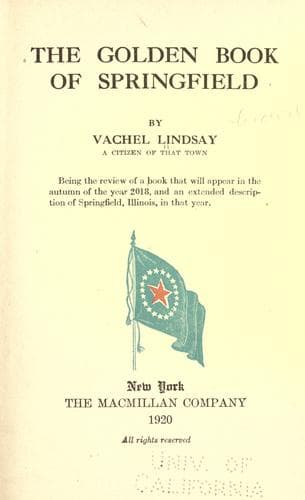
Springfield (Ill.) -- Fiction; Springfield (Ill.) -- In literature; Utopias in literature
She goes on to tell how her mother came of two long lines of Springfield
Catholics. And I gather, as Avanel talks on and on, and I piece it out
from dim memories that float about the back of my head, that two lines
of her mother’s house were the one Irish, and the other Lithuanian, and
that long ago this woman was the most famous dancer of The Gordon Craig
Theatre. She died in Avanel’s fifteenth year. And it seemed in the local
fitness of things for the little girl with the same talent to go forward
bearing the same responsibilities as soon as she could carry them,
dancers coming to their own early, if they ever have a place. She was
soon the head of all those who could make Springfield’s devotional
ideals clear and appealing, through those inherited rituals. Avanel and
her group have danced for the Churches at Christmas and other times,
and, in the history of her art most important of all, the festivals of
Johnny Appleseed, and of St. Scribe and Hunter Kelly. And now I begin to
remember with her some of those occasions as through rifts of cloud.
Now Avanel says she does not want me to be seen in the audience where
she gives a religious dance. She is angry with herself and me, because
she is herself flattening out so, after talking on religious matters.
But I am philosophical about this young woman, today, and look about at
what we are passing.
We stare silently into the windows at adding machines, mantels,
grates, and tiles. We pass a wholesale house for barber supplies, and
Avanel says I need a hair cut. We pass the business houses of
feather-renovators and dealers, of dealers in safes and locks, and
rubber stamps. I note aloud in passing that Avanel has many rubber
stamp ideas and needs to alter them if she would do justice to her
glorious face. She answers not. We walk on. We pass through a
wholesale region, and while the fog still conceals the towers of the
town and comes lower, we can look into the windows yet, and I note
that this is not as in the century before. Almost every wholesaler has
a dazzling insignia and coat of arms. This is true for instance of the
manufacturing machinists and millwrights, the headquarters for
tempering and dies. It is true, even, of the dealers in sand and
gravel, the tinners and slate roofers, the transfer and trucking
companies, the brick and tile manufacturers, the soda water
manufacturers, the pump manufacturers, the cigar manufacturers, the
leather and belting men, and many others that to me were most
commonplace of old. But their window displays are as the throne rooms
of knighthood.
Public-domain text, read in full here on John Shaqi.
Reviews
Reviews
No reviews yet
Be the first to share your thoughts on this work.
Join the Discussion
Join the discussion
Sign in to leave a comment or review.
Sign InorCreate an account