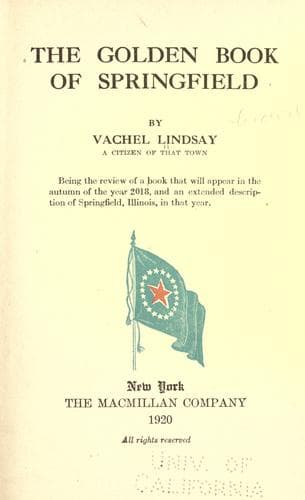
Springfield (Ill.) -- Fiction; Springfield (Ill.) -- In literature; Utopias in literature
It is late in the evening, and I am with Avanel on top of the Truth
Tower, and she is relenting, not so much toward me, as toward her town.
It is the first time she has taken in the panorama, since the last
circle of towers was completed and The Street of Past History
illuminated.
“I must admit,” she says, “the civic patriotism of two most
unfashionable persons. Old Joseph Bartholdi Michael, the Second, who is
away now at the legislature of the World Government, is the head of our
whole architectural project. He is something of a Smart Set person, and
is in fact an old West Pointer. But the real work was done by the most
unpopular Thibetan Boy and the architectural planning and imagining was
by the negro John Emis. Old Joseph Bartholdi Michael, the Second, has
lent his name to protect these people, and leave them unmolested in
their project. As it is, he turns his appropriation over to them. The
city would not give either of such a salary. It will give the Thibetan
Boy a little credit, when all is over, but John Emis none at all,
because he is a negro. When you go down into the streets again you will
find a black stripe tucked away in some odd corner of the design of
every building in The Street of Past History. If you look you will see
that same stripe now, on the outer circle of towers. It goes slenderly
around the fourth story and the tenth. That black stripe is the personal
secret signature of John Emis, the negro architect.”
The voice of this woman beside me alters to that gentle and human tone
in which she spoke of her mother, as though this city, too, has its hand
somewhat on her heart. Yet she is proud and almost barks at me when I
attempt any kind of understanding, and to her I am not of this city, and
my sole excuse for living is that I admire her, and therefore must be
forgiven every other trait in my character till she has time to mend my
ways. My scalp must dangle at her belt.
“I begin to be almost reconciled to living in Springfield,” she muses,
“Springfield is all society, you know, and it is hopeless to try to make
it anything else. Of course there are some places where it pays to have
ideas, but here a girl must conceal ideas if she has them.”
Then, in an instant, another Avanel seems to flash forth. “You think I
am a snob and a fool, you silly art student, but I would die for the
International Flag far sooner than people like your idol Sparrow Short.”
Avanel points out to me old Camp Lincoln, northwest, beyond the towers.
There she leads the Amazonian Cavalry and the Horseshoe Brotherhood in
bi-weekly drill, in preparation for the possible war against Singapore.
Looming like the dome of the Taj Mahal above the trees is a gigantic
world globe, which marks the center of the field. Around this shining
map of everything her drills are held.
But I answer her cut: “Sparrow Short is no idol of mine, and you know
it. I regard him as the best teacher of art in Springfield, but I do not
accept his international views.”
Public-domain text, read in full here on John Shaqi.
Reviews
Reviews
No reviews yet
Be the first to share your thoughts on this work.
Join the Discussion
Join the discussion
Sign in to leave a comment or review.
Sign InorCreate an account