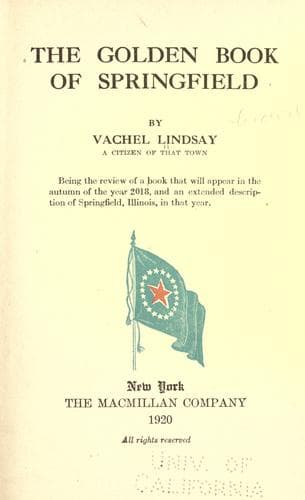
Springfield (Ill.) -- Fiction; Springfield (Ill.) -- In literature; Utopias in literature
April 3, 2018:—It is a sunny April morning. I note some tiny spring
beauties in the patches of snow. Every cloud threatens, but every cloud
rolls by. I begin to apprehend April’s pretty promise of final
deliverance from frost and snow. I am loafing around the coffee houses,
listening to the talk, and being received as one of the more obscure
inhabitants. Occasionally some one asks, with an effort at interest, if
I am starting my art classes soon. But the most lofty and the most
humble call me “cousin,” as they do one another. I am sounded a bit as
to whether I share the political opinions of Sparrow Short, and
incidentally if we belong to the same school of art teaching, and if he
will give my classes a criticism from time to time. I write down the
name of the youth who seeks me out desiring to enroll and am for the
first time flattered.
By putting fugitive bits of loud talk with observations of the last few
mornings, I begin to get the social fabric, and take a lesson in New
Springfield’s politics.
More women vote than men. Woman is the housekeeper and municipal
politics is a kind of nest building and a house keeping of a sort.
The women follow their old occupations. And they have many new ones.
They are locksmiths, safe experts, confectioners, cigar factory workers
and owners, makers of advertising novelties for the whole world, eye,
ear, nose and throat physicians, bill posters, wallpaper cleaners,
opticians, dog, cat, and bird doctors, barbers, undertakers,
auctioneers, dentists, and a thousand other things. But this does not
mean that women monopolize such occupations. It is only a minority that
leaves the home. But it is a majority that floods the elections. They
are about equally divided between the established factions among the men
and perhaps getting the mass of their opinions from the men but
certainly furnishing their own steam.
I note many curious phases of caste, if there may be said to be such in
a fluent community where everyone may change his status before nightfall
by doughty deed or awful failure. There is an exalted status to
occupations that were once deemed commonplace. There is yet the same
distinction that used to go to lawyer or doctor or head of a university
department, but it is extended to such seemingly miscellaneous
occupations as conductors of Turkish baths, special gymnasiums and mud
baths, billiard halls, bowling alleys. Stores for sporting and athletic
goods convey great distinction. And the demi-god of these, Cave Man
Thomas, is indeed held in high regard and his minions have almost the
same lustre, and so he is one of the eleven city commissioners.
But the end of these surprises is not complete. There is a particular
dignity given to junk dealers, cobblers, garbage handlers, and
manufacturers, and devisers of patent medicines. They stand as did the
lords, dukes, knights, and bishops of old, if there is a charm to their
private characters equal to that of their public service.
Public-domain text, read in full here on John Shaqi.
Reviews
Reviews
No reviews yet
Be the first to share your thoughts on this work.
Join the Discussion
Join the discussion
Sign in to leave a comment or review.
Sign InorCreate an account