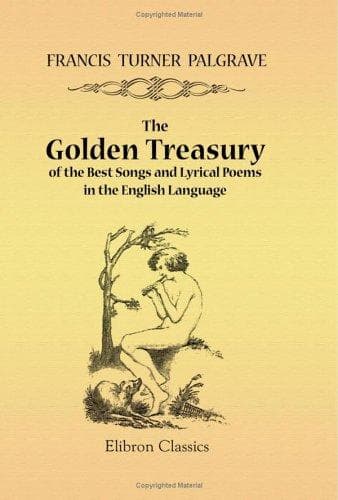
The Golden Treasury: Of the Best Songs and Lyrical Poems in the English Language
General
The Golden Treasury: Of the Best Songs and Lyrical Poems in the English Language
English poetry; Songs, English -- Texts
This division, embracing the latter eighty years of the seventeenth
century, contains the close of our Early poetical style and the
commencement of the Modern. In Dryden we see the first master of the
new: in Milton, whose genius dominates here as Shakespeare's in the
former book,--the crown and consummation of the early period. Their
splendid Odes are far in advance of any prior attempts, Spenser's
excepted: they exhibit the wider and grander range which years and
experience and the struggles of the time conferred on Poetry. Poetry now
gave expression to political feeling, to religious thought, to a high
philosophic statesmanship in writers such as Marvell, Herbert, and
Wotton: whilst in Marvell and Milton, again, we find the first noble
attempts at pure description of nature, destined in our own ages to be
continued and equalled. Meanwhile the poetry of simple passion, although
before 1660 often deformed by verbal fancies and conceits of thought,
and afterward by levity and an artificial tone,--produced in Herrick and
Waller some charming pieces of more finished art than the Elizabethan:
until in the courtly compliments of Sedley it seems to exhaust itself,
and lie almost dormant for the hundred years between the days of Wither
and Suckling and the days of Burns and Cowper.--That the change from our
early style to the modern brought with it at first a loss of nature and
simplicity is undeniable: yet the far bolder and wider scope which
Poetry took between 1620 and 1700, and the successful efforts then made
to gain greater clearness in expression, in their results have been no
slight compensation.
62. ODE ON THE MORNING OF CHRIST'S NATIVITY.
This is the month, and this the happy morn
Wherein the Son of Heaven's Eternal King
Of wedded maid and virgin mother born,
Our great redemption from above did bring;
For so the holy sages once did sing
That He our deadly forfeit should release,
And with His Father work us a perpetual peace.
That glorious Form, that Light unsufferable,
And that far-beaming blaze of Majesty
Wherewith He wont at Heaven's high council-table
To sit the midst of Trinal Unity,
He laid aside; and, here with us to be,
Forsook the courts of everlasting day,
And chose with us a darksome house of mortal clay.
Say, heavenly Muse, shall not thy sacred vein
Afford a present to the Infant God?
Hast thou no verse, no hymn, or solemn strain
To welcome Him to this His new abode,
Now while the heaven, by the sun's team untrod,
Hath took no print of the approaching light,
And all the spangled host keep watch in squadrons bright?
Public-domain text, read in full here on John Shaqi.
Reviews
Reviews
No reviews yet
Be the first to share your thoughts on this work.
Join the Discussion
Join the discussion
Sign in to leave a comment or review.
Sign InorCreate an account