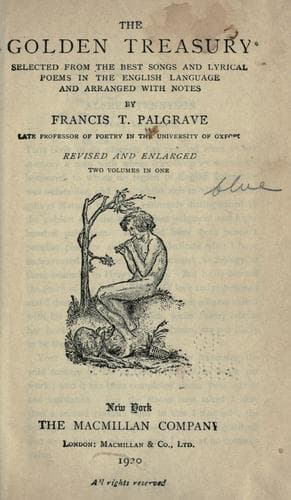
The Golden Treasury: Selected from the Best Songs and Lyrical Poems in the English Language and arranged with Notes
General
The Golden Treasury: Selected from the Best Songs and Lyrical Poems in the English Language and arranged with Notes
English poetry; Songs, English -- Texts
180 193 _fou_, merry with drink: _coost_, carried: _unco skeigh_, very
proud: _gart_, forced: _abeigh_, aside: _Ailsa craig_, a rock in the Firth
of Clyde: _grat his een bleert_, cried till his eyes were bleared:
_lowpin_, leaping: _linn_, waterfall: _sair_, sore: _smoor'd_, smothered:
_crouse_ and _canty_, blithe and gay.
181 194 Burns justly named this 'one of the most beautiful songs in
the Scots or any other language.' One stanza, interpolated by Beattie,
is here omitted:--it contains two good lines, but is out of harmony
with the original poem. _Bigonet_, little cap: probably altered from
_béguinette_: _thraw_, twist: _caller_, fresh.
182 195 Burns himself, despite two attempts, failed to improve this
little absolute masterpiece of music, tenderness, and simplicity: this
'Romance of a life' in eight lines.--_Eerie_: strictly, scared:
uneasy.
183 196 _airts_, quarters: _row_, roll: _shaw_, small wood in a
hollow, spinney: _knowes_, knolls. The last two stanzas are not by
Burns.
184 197 _jo_, sweetheart: _brent_, smooth: _pow_, head.
-- 198 _leal_, faithful. St. 3 _fain_, happy.
185 199 Henry VI founded Eton.
188 200 Written in 1773, towards the beginning of Cowper's second
attack of melancholy madness--a time when he altogether gave up
prayer, saying, 'For him to implore mercy would only anger God the
more.' Yet had he given it up when sane, it would have been 'maior
insania.'
191 203 The Editor would venture to class in the very first rank this
Sonnet, which, with 204, records Cowper's gratitude to the Lady whose
affectionate care for many years gave what sweetness he could enjoy to
a life radically wretched. Petrarch's sonnets have a more ethereal
grace and a more perfect finish; Shakespeare's more passion; Milton's
stand supreme in stateliness; Wordsworth's in depth and delicacy. But
Cowper's unites with an exquisiteness in the turn of thought which the
ancients would have called Irony, an intensity of pathetic tenderness
peculiar to his loving and ingenuous nature.--There is much mannerism,
much that is unimportant or of now exhausted interest in his poems:
but where he is great, it is with that elementary greatness which
rests on the most universal human feelings. Cowper is our highest
master in simple pathos.
193 205 Cowper's last original poem, founded upon a story told in
Anson's 'Voyages.' It was written March 1799; he died in next year's
April.
195 206 Very little except his name appears recoverable with regard
to the author of this truly noble poem, which appeared in the
'Scripscrapologia, or Collins' Doggerel Dish of All Sorts,' with three
or four other pieces of merit, Birmingham, 1804.--_Everlasting_; used
with side-allusion to a cloth so named, at the time when Collins
wrote.
_Summary of Book Fourth_
Public-domain text, read in full here on John Shaqi.
Reviews
Reviews
No reviews yet
Be the first to share your thoughts on this work.
Elsewhere in the archive
Join the Discussion
Join the discussion
Sign in to leave a comment or review.
Sign InorCreate an account