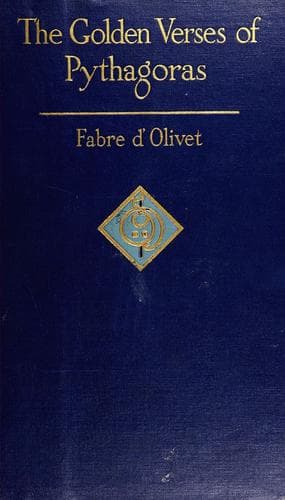
The golden verses of PythagorasFabre d'Olivet, Antoine
Religion
The golden verses of Pythagoras
Fabre d'Olivet, Antoine
Poetry -- History and criticism; Pythagoras and Pythagorean school
themselves in captious arguments in order to prove that they knew
nothing, and making for themselves the calamitous glory of ignoring
good and evil, and of being unable to distinguish virtue from
vice.[489] Dismal effect of an early error! Arcesilaus became the
convincing proof of what I have repeated touching the golden mean and
the similitude of extremes: once having left the path of truth, he
became through weakness and through superstition the head of a crowd
of audacious atheists, who, after having called in question the
principles upon which logic and morals repose, placed there those of
religion and overthrew them. Vainly he essayed to arrest the movement
of which he had been the cause by establishing two doctrines: the one
public, wherein he taught skepticism; the other secret, wherein he
maintained dogmatism[490]: the time was no longer favourable for this
distinction. All that he gained was to let another usurp the glory and
to give his name to the new sect of doubters. It was Pyrrho who had
this honour. This man, of a character as firm as impassive, to whom
living or dying was a matter of indifference, who preferred nothing to
something, whom a precipice opening beneath his feet would be unable
to swerve from his path, gathered under his colours all those who made
a philosophical profession of doubting everything, of recognizing
nowhere the character of truth, and he gave them a sort of doctrine
wherein wisdom was placed in the most complete uncertainty, felicity
in the most absolute inertia, and genius in the art of stifling all
kinds of genius by the accumulation of contradictory reasonings.[491]
Pyrrho had much contempt for men, as was obvious from the doctrine
which he gave them. He had constantly on his lips this line of Homer:
“Even as are the generations of leaves such are those likewise of
men.”[492]
I pause a moment here, in order that the reader may observe, that
although the thought of Hesiod, concerning the veil that the gods had
spread between them and men, and which gave rise to Arcesilaus
establishing his acatalepsy, had originated in India,[493] it had
never had the same results there; and this, because the Brahmans, in
teaching that this veil existed and that it even bewildered the vulgar
by a series of illusory phenomena, have never said that it was
impossible to raise it; because this might have been an attack on the
power of the will of man and its perfectibility, to which they put no
limit. We shall see further on that such was also the idea of
Pythagoras. Let us return to the Skeptics.
Public-domain text, read in full here on John Shaqi.
Reviews
Reviews
No reviews yet
Be the first to share your thoughts on this work.
Elsewhere in the archive
Join the Discussion
Join the discussion
Sign in to leave a comment or review.
Sign InorCreate an account