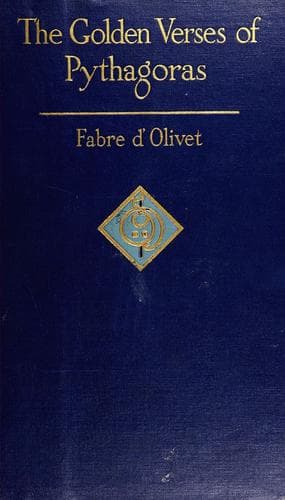
The golden verses of PythagorasFabre d'Olivet, Antoine
Religion
The golden verses of Pythagoras
Fabre d'Olivet, Antoine
Poetry -- History and criticism; Pythagoras and Pythagorean school
The writer to whom we owe a comparative history of the systems of
philosophy, written with thought and impartiality, has felt keenly
that skepticism ought to be considered under two relations: as
skepticism of criticism and reform, necessary to correct the
presumption of the human mind and to destroy its prejudices; as
skepticism absolute and determined, which confounds in a common
proscription both truth and error.[494] The first, of which Socrates
gave the example, and which Bacon and Descartes have revived, is a
sort of intellectual remedy that Providence prepares for healing one
of the most fatal maladies of the human mind, that kind of
presumptuous ignorance which makes one believe that he knows that
which he does not know: the second, which is only the excess and abuse
of the first, is this same remedy transformed into poison by an
aberration of the human reason which transports it beyond the
circumstances which invoke its action, and employs it to devour itself
and to exhaust in their source all the causes which cooperate in the
progress of human understanding.[495] Arcesilaus was the first to
introduce it into the Academy by exaggerating the maxims of Socrates,
and Pyrrho made a special system of destruction in it, under the name
of _Pyrrhonism_. This system, welcomed in Greece, soon infected it
with its venom, notwithstanding the vigorous resistance of Zeno the
Stoic, whom Providence had raised up to oppose its ravages.[496]
Carried to Rome by Carneades, the head of the third academy, it
alarmed with its maxims subversive of public morals, Cato the Censor,
who confounding it with philosophy conceived for it an implacable
hatred.[497] This rigid republican, hearing Carneades speak against
justice, denying the existence of virtues, attacking the Divine
Providence, and questioning the fundamental verities of religion, held
in contempt a science which could bring forth such arguments.[498] He
urged the return of the Greek philosophy, so that the Roman youth
might not be imbued with its errors; but the evil was done. The
destructive germs that Carneades had left, fermented secretly in the
heart of the State, developed under the first favourable conditions,
increased and produced at last that formidable colossus, which, after
taking possession of the public mind, having obscured the most
enlightened ideas of good and evil, annihilated religion, and
delivered the Republic to disorder, civil wars, and destruction; and
raising itself again with the Roman Empire, withering the principles
of the life it had received, necessitated the institution of a new
cult and thus was exposed to the incursion of foreign errors and the
arms of the barbarians. This colossus, victim of its own fury, after
having torn and devoured itself was buried beneath the shams that it
had heaped up; Ignorance seated upon its _débris_ governed Europe,
until Bacon and Descartes came and resuscitating, as much as was
Public-domain text, read in full here on John Shaqi.
Reviews
Reviews
No reviews yet
Be the first to share your thoughts on this work.
Elsewhere in the archive
Join the Discussion
Join the discussion
Sign in to leave a comment or review.
Sign InorCreate an account