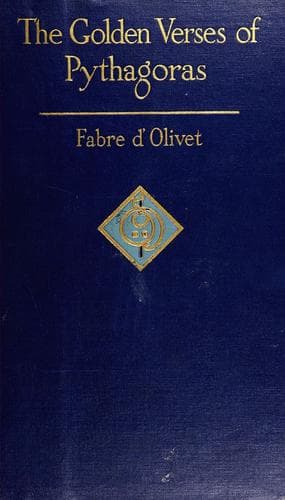
The golden verses of PythagorasFabre d'Olivet, Antoine
Religion
The golden verses of Pythagoras
Fabre d'Olivet, Antoine
Poetry -- History and criticism; Pythagoras and Pythagorean school
26. _But before all, thy soul to its faithful duty,
Invoke these Gods with fervour, they whose aid,
Thy work begun, alone can terminate._
All the cults established upon the face of the earth have made a
religious duty of prayer. This alone would prove, if it were
necessary, what I have advanced concerning the theosophical dogma of
the volitive liberty of man; for if man were not free in his actions,
and if an irresistible fatality led him on to misfortune and to crime,
what use would be invoking the gods, imploring their assistance,
begging them to turn aside from him the evils which must inevitably
overwhelm him? If, as Epicurus taught, an impenetrable barrier
separated gods and men; if these gods, absorbed in their beatitude and
their impassive immortality, were such strangers to the evils of
humanity that they neither troubled to alleviate them nor to prevent
them, for what purpose then the incense burning at the foot of their
altars?[558]
It was, he said, on account of the excellence of their nature that he
honoured them thus, and not from any motive of hope or fear, not
expecting any good from them and not dreading any evil.[559] What
miserable sophism! How could Epicurus say such a thing before having
explained clearly and without amphibology, what the origin of good and
evil is, so as to prove that the gods indeed do not cooperate either
for the augmentation of the one, or the diminution of the other? But
Epicurus had never dreamed of giving this explanation. However little
he might have considered it, he would have seen that in whatever
fashion he had given it, it would have overthrown the doctrine of
atoms; for a sole principle, whatever it may be, cannot produce at the
same time good and evil. Nevertheless, if he has not explained this
origin, and if he has not shown in a peremptory way that we are in a
sphere where absolute evil reigns, and that consequently we can have
no sort of communication with that wherein good resides, it will
remain always evident that if we are not in such a sphere, and if we
possess a portion of good, this good must come to us from the sphere
wherein absolute good has its source. Now, this sphere is precisely
that in which Epicurus places the gods.[560] But, perhaps, a defender
of Epicurus will say, the good that we possess comes to us only once
from the divine sphere and thenceforth it comes to us no more. This is
contrary to the most intimate and most general notion that we have of
the Divinity, to that of its immutability upon which Epicurus himself
leans most, and from which it results that the gods could never be
what they have been, nor do what they have done.
Public-domain text, read in full here on John Shaqi.
Reviews
Reviews
No reviews yet
Be the first to share your thoughts on this work.
Elsewhere in the archive
Join the Discussion
Join the discussion
Sign in to leave a comment or review.
Sign InorCreate an account