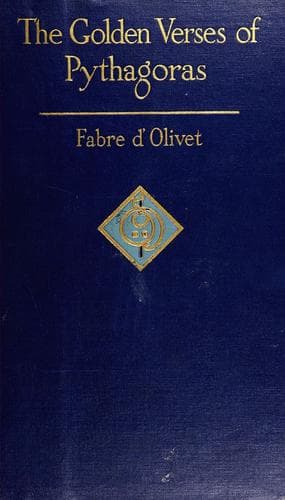
The golden verses of PythagorasFabre d'Olivet, Antoine
Religion
The golden verses of Pythagoras
Fabre d'Olivet, Antoine
Poetry -- History and criticism; Pythagoras and Pythagorean school
In one word, just as well as in a thousand, any maker of a system is
obliged to do one of two things, either to declare himself what the
origin is of good and evil, or to admit _a priori_ the theosophical
dogma of the liberty of man. Epicurus knew this, and although this
dogma might ruin his system completely, he preferred to admit it than
expose himself to give an explanation beyond his capability and beyond
that of all men. But if man is free, he can be counselled; if he can
be counselled, it is evident that he can, even that he must, demand
counsel. This is the rational principle of prayer. Now, common sense
is the asking for counsel wiser than its own, and sagacity shows in
the Gods the source of wisdom.
Epicurus, nevertheless, denied the intervention of divine Providence
and pretended that the Gods, absorbed in their supreme felicity, do
not mingle in any affair.[561] A single question, simple and naïve,
would overthrow this assertion destitute of proofs, and besides,
inconsistent with the conduct of Greek philosophy; but I prefer to
leave this question to Bayle, who has expended much logic in
sustaining this point. This French philosopher, under pretext of
making Epicurus dispute with a polytheistic priest, advances against
Providence an argument which he believes irresistible, and which is,
indeed, one of the most subtle that one could possibly advance. “Are
the gods satisfied with their administration or are they dissatisfied?
Be mindful,” he says, “of my dilemma: if they are satisfied with what
comes to pass under their providence, they are pleased with evil; if
they are dissatisfied, they are unhappy.”[562] The manner in which
Bayle throws himself into the midst of the question, without examining
the principles of it, denounces him as a skeptic; it is necessary
therefore to use against him the weapons that I have given against
skepticism; that is, to bring him back abruptly to the principles, by
interrogating him before replying to him. It is necessary to ask him,
if he admits a difference between that which is and that which is not?
He is forced to admit it, as I have said; for in whatever region of
himself his will takes refuge, whether it exercises its judgment in
the instinct, in the understanding or in the intelligence, you will
pursue it in him opposing, in the first case, the axiom of common
sense: nothing is made from nothing; in the second, that of reason:
that which is, is; in the last, that of sagacity: everything has its
opposite and can have only one. Nothing is made from nothing therefore
that which is not, can never produce that which is. That which is, is;
therefore, that which is not, is not that which is. Everything has its
opposite and can have only one; therefore the absolute opposite of
that which is, is that which is not. If the skeptic refuses himself
the evidence of common sense, of reason and of sagacity united, he
lies to his conscience, or he is mad and then one must leave him.
Public-domain text, read in full here on John Shaqi.
Reviews
Reviews
No reviews yet
Be the first to share your thoughts on this work.
Elsewhere in the archive
Join the Discussion
Join the discussion
Sign in to leave a comment or review.
Sign InorCreate an account