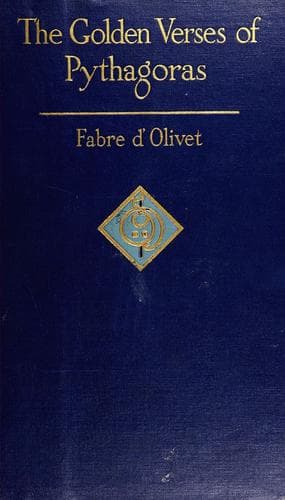
The golden verses of PythagorasFabre d'Olivet, Antoine
Religion
The golden verses of Pythagoras
Fabre d'Olivet, Antoine
Poetry -- History and criticism; Pythagoras and Pythagorean school
Man [he said] is free to do good or evil: he who tries to
lay the blame of his vices on the weakness of nature, is
unjust: for what is sin, in general? Is it a thing that one
may evade, or not? If one cannot evade it, there is no evil
in committing it and then it does not exist: if one can
evade it, it must be evil to commit it and therefore it
exists: its very existence is born of the free will, and
proves it.[618] The dogma of original sin [continued
Pelagius] is absurd and unjust to God; for a creature which
does not exist would not be an accomplice of a bad action;
and it outrages divine justice, to say that God punishes him
as guilty of this action.[619] Man [added Pelagius] has
therefore a real power of doing good and evil, and he is
free in these two respects. But the liberty of doing a thing
supposes necessarily the union of all causes and of all
conditions requisite for doing that thing; and one is not
free regarding an effect, every time that one of the causes
or conditions naturally exigent for producing this effect is
lacking. Therefore, to have the liberty of seeing the
subjects, it is necessary not only that the sense of sight
be well developed, but also that the subjects be
discriminated, and placed at an equitable distance.[620]
This far, the doctrine of Pelagius was wholly similar to that of
Pythagoras, as explained by Hierocles[621]; but it differs from it
afterwards, in what the English monk asserted, that since man is born
with the liberty of doing good and evil, he receives from nature and
unites in him all the conditions and all the causes naturally
necessary for good and evil; which robs him of his most beautiful
prerogative,――perfectibility; whereas Pythagoras held, on the
contrary, that these causes and these effects were only accorded to
those who, on their part, concurred in acquiring them, and who, by the
work that they have done for themselves in seeking to know themselves,
have succeeded in possessing them more and more perfectly.
Public-domain text, read in full here on John Shaqi.
Reviews
Reviews
No reviews yet
Be the first to share your thoughts on this work.
Elsewhere in the archive
Join the Discussion
Join the discussion
Sign in to leave a comment or review.
Sign InorCreate an account