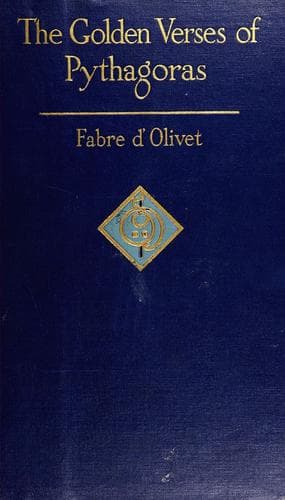
The golden verses of PythagorasFabre d'Olivet, Antoine
Religion
The golden verses of Pythagoras
Fabre d'Olivet, Antoine
Poetry -- History and criticism; Pythagoras and Pythagorean school
However mitigated the doctrine of Pelagius might be, it appeared still
to accord too much with free will and was condemned by the
ecclesiastical authorities, who declared, through the medium of
several councils, that man can do nothing of himself without the aid
of grace. Saint Augustine, who had been the soul of these councils,
pressed by the disciple of Pelagius to explain the nature of this
grace and to say how God accorded it to one man rather than to another
without being induced by the difference of their merits, replied that
man being in the _masse de perdition_, and God having no need of them,
and being furthermore independent and all-powerful, he gave grace to
whom he willed, without the one to whom he did not give it having the
right to complain; everything coming to pass as a result of his will,
which had foreseen all and determined all.[622] Assuredly one could
not establish more forcibly the necessity of all things, nor submit
men to a sterner fatality, since the want of grace deprived them, not
only of virtue in the fleeting course of this life, but delivered them
without hope to the torments of an eternal hell. But Saint Augustine,
who obeyed a severe and consistent reason, felt very well that he
could not speak otherwise, without renouncing the dogma of original
sin and overthrowing the foundation of Christianity. All the rigid
Christians, all those who, at different times, have undertaken to
restore Christianity to its constitutive principles, have thought as
Saint Augustine, and although the church, alarmed at the terrible
inferences that were drawn from the canonical doctrine, may have
essayed to temper it, by condemning, as I have said, the
Predestinarians and by approving of the persecutions directed against
Gotescalc; and, at the time when Luther drew in his reform a great
part of Christendom toward the dogma of predestination, this did not
prevent Baius, who remained faithful to orthodoxy, from preaching the
same dogma; nor Calvin, soon after, from adding new lights to what
Luther had left doubtful, and Jansenius, finally, corroborating what
Baius had only outlined, from raising in the very midst of the church
that formidable faction which all the united efforts of the Pope and
the Jesuits have been unable to convict of erring in the doctrine of
Saint Augustine, which it has sustained with a force worthy of a
better cause.
Public-domain text, read in full here on John Shaqi.
Reviews
Reviews
No reviews yet
Be the first to share your thoughts on this work.
Elsewhere in the archive
Join the Discussion
Join the discussion
Sign in to leave a comment or review.
Sign InorCreate an account