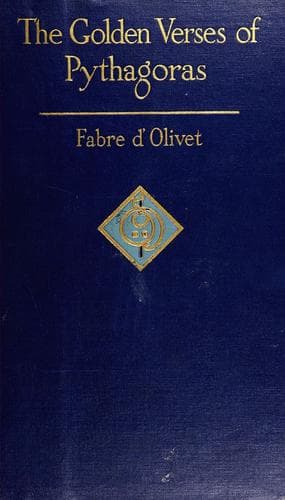
The golden verses of PythagorasFabre d'Olivet, Antoine
Religion
The golden verses of Pythagoras
Fabre d'Olivet, Antoine
Poetry -- History and criticism; Pythagoras and Pythagorean school
Lysis shows in these lines what are the greatest obstacles to the
happiness of man. They are the passions: not the passions in
themselves, but the evil effects that they produce by the disordered
movement that the understanding allows them to take. It is to this
that the attention must be directed so that one should not fall into
the error of the Stoics. Pythagoras, as I have said, did not command
his disciples to destroy their passions, but to moderate their ardour,
and to guide them well. “The passions,” said this philosopher, “are
given to be aids to reason; it is necessary that they be its servants
and not its masters.” This is a truth that the Platonists and even the
Peripatetics have recognized, by the evidence of Hierocles.[631] Thus
Pythagoras regarded the passions as instruments of which the
understanding makes use in raising the intellectual edifice. A man
utterly deprived of them would resemble a mass inert and immovable in
the course of life; it is true that he might be able not to become
depraved, but then he could not enjoy his noblest advantage, which is
perfectibility. Reason is established in the understanding to hold
sway over the passions; it must command them with absolute
sovereignty, and make them tend towards the end that wisdom indicates.
If it should not recognize the laws that intelligence gives it, and
if, presumptuously, it wishes, instead of acting according to given
principles, to lay down principles itself, it falls into excess, and
makes man superstitious or skeptic, fanatic or atheist; if, on the
contrary, it receives laws from the passions that it ought to rule,
and if weak it allows itself to be subjugated by them, it falls into
error and renders man stupid or mad, brutish in vice, or audacious in
crime. There are no true reasonings except those admitted by wisdom;
the false reasonings must be considered as the cries of an insensate
soul, given over to the movements of an anarchical reason which the
passions confuse and blind.[632]
Public-domain text, read in full here on John Shaqi.
Reviews
Reviews
No reviews yet
Be the first to share your thoughts on this work.
Elsewhere in the archive
Join the Discussion
Join the discussion
Sign in to leave a comment or review.
Sign InorCreate an account