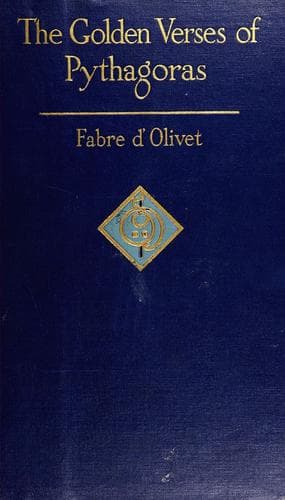
The golden verses of PythagorasFabre d'Olivet, Antoine
Religion
The golden verses of Pythagoras
Fabre d'Olivet, Antoine
Poetry -- History and criticism; Pythagoras and Pythagorean school
Pythagoras considered man as holding the mean between things
intellectual and sentient, the lowest of the superior beings and the
highest of the inferior, free to move either toward the heights or the
depths, by means of his passions, which bring into action the
ascending or descending movement that his will possesses with
potentiality; sometimes being united with the immortals and, through
his return to virtue, recovering the lot which is his own, and other
times plunging again into mortal kind and through transgression of the
divine laws finding himself fallen from his dignity.[633] This
opinion, which had been that of all the sages who had preceded
Pythagoras, has been that of all the sages who have followed him, even
of those among the Christian theosophists whose religious prejudices
have removed them farthest from his doctrine. I shall not stop to give
the proofs of its antiquity; they are to be found everywhere, and
would be superfluous. Thomas Burnet, having vainly sought for the
origin without being able to discover it, decided that it was
necessary that it should descend from heaven.[634] It is certain that
one can only with difficulty explain how a man without erudition, like
Boehme, never having received this opinion from anyone, has been able
to explain it so clearly. “When one sees man existing,” says this
theosophist, “one can say: Here all Eternity is manifested in one
image.”[635]
The abode of this being is an intermediate point between
heaven and hell, love and anger; that, of the things to
which he is attached, becomes his kind.… If he inclines
toward the celestial nature, he assumes a celestial form,
and the human form becomes infernal if he inclines toward
hell; for as the mind is, so is the body. In whatever way
the mind projects itself, it shadows forth its body with a
similar form and a similar source.[636]
It is upon this principle, which one finds still everywhere diversely
expressed, that the dogma of the transmigration of souls is founded.
This dogma, explained in the ancient mysteries,[637] and received by
all peoples,[638] has been to such an extent disfigured in what the
moderns have called _Metempsychosis_, that it would be necessary to
exceed considerably the limits of these Examinations in order to give
an explanation which could be understood. Later I will endeavour to
expose my sentiment upon this mystery, when I treat of Theurgy and
other occult sciences to which it is allied.
33. _God! Thou couldst save them by opening their eyes._
Public-domain text, read in full here on John Shaqi.
Reviews
Reviews
No reviews yet
Be the first to share your thoughts on this work.
Elsewhere in the archive
Join the Discussion
Join the discussion
Sign in to leave a comment or review.
Sign InorCreate an account