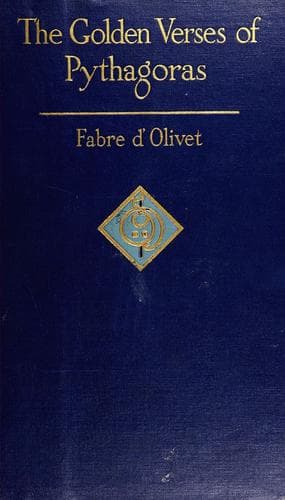
The golden verses of PythagorasFabre d'Olivet, Antoine
Religion
The golden verses of Pythagoras
Fabre d'Olivet, Antoine
Poetry -- History and criticism; Pythagoras and Pythagorean school
Besides [these same naturalists continue], the greater part
of the fossil bones that have been assembled and compared
are those of animals different from any of the species
actually known; has the kingdom of life therefore changed?
This one cannot refuse to believe.[659] As Nature proceeds
unceasingly from the simple to the composite, it is probable
that the most imperfect animals should have been created
before the tribes, higher in the scale of life. It even
seems that each of the animal classes indicates a sort of
suspension in the creative power, an intermission, an era of
repose, during which Nature prepared in silence the germs of
life which should come to light in the course of the cycles.
One might thus enumerate the epochs of living Nature, epochs
remote in the night of ages and which have been obliged to
precede the formation of mankind. A time may have been when
the insect, the shell, the unclean reptile, did not
recognize the master in the Universe and were placed at the
head of the organized bodies.[660]
These observers add:
It is certain that most perfect beings come from less
perfect, and that they are obliged to be perfected in the
sequence of generations. All animals tend towards man; all
vegetables aspire to animality; minerals seek to draw nearer
to the vegetable.… It is evident that Nature, having created
a series of plants and animals, and having stopped at man
who forms the superior extremity, has assembled in him all
the vital faculties that it had distributed among the
inferior races.[661]
These are the ideas of Leibnitz. This celebrated man had said: “Men
hold to animals; these to plants, and those to fossils. It is
necessary that all the natural orders form only one sole chain, in
which the different classes hold strictly as if they were its
links.”[662] Several philosophers have adopted them,[663] but none
have expressed them with more order and energy than the author of the
article _Nature_, in _Le Nouveau Dictionnaire d’Histoire naturelle_.
Public-domain text, read in full here on John Shaqi.
Reviews
Reviews
No reviews yet
Be the first to share your thoughts on this work.
Elsewhere in the archive
Join the Discussion
Join the discussion
Sign in to leave a comment or review.
Sign InorCreate an account