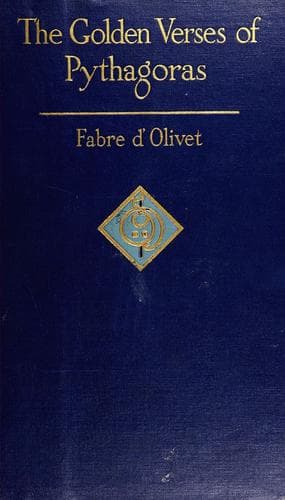
The golden verses of PythagorasFabre d'Olivet, Antoine
Religion
The golden verses of Pythagoras
Fabre d'Olivet, Antoine
Poetry -- History and criticism; Pythagoras and Pythagorean school
All animals, all plants are only the modifications of an
animal, of a vegetable origin.… Man is the knot which unites
the Divinity to matter, which links heaven and earth. This
ray of wisdom and intelligence which shines in his thoughts
is reflected upon all Nature. It is the chain of
communication between all beings. All the series of animals
[he adds in another place] present only a long degradation
from the proper nature of man. The monkey, considered either
in his exterior form or in his interior organization,
resembles only a degraded man; and the same suggestion of
degradation is observed in passing from monkeys to
quadrupeds; so that the primitive trend of the organization
is recognized in all, and the principal viscera, the
principal members are identical there.[664]
Who knows [observes elsewhere the same writer] who knows if
in the eternal night of time the sceptre of the world will
not pass from the hands of man into those of a being more
worthy of bearing it and more perfect? Perhaps the race of
negroes, today secondary in the human specie, has already
been queen of the earth before the white race was created.…
If Nature has successively accorded the empire to the
species that it creates more and more perfect, why should
she cease today.… The negro, already king of animals, has
fallen beneath the yoke of the European; will the latter bow
the head in his turn before a race more powerful and more
intelligent when it enters into the plans of Nature to
ordain his existence? Where will his creation stop? Who will
place the limits of his power? God alone raises it and it is
His all-powerful hand which governs.[665]
These striking passages full of forceful ideas, which appear new, and
which would merit being better known, contain only a small part of the
things taught in the ancient mysteries, as I shall perhaps demonstrate
later.
36. … _Thou who fathomed it.
O wise and happy man, rest in its haven.
But observe my laws, abstaining from the things
Which thy soul must fear, distinguishing them well;
Letting intelligence o’er thy body reign._
Public-domain text, read in full here on John Shaqi.
Reviews
Reviews
No reviews yet
Be the first to share your thoughts on this work.
Elsewhere in the archive
Join the Discussion
Join the discussion
Sign in to leave a comment or review.
Sign InorCreate an account