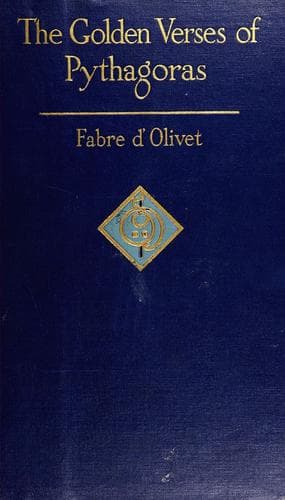
The golden verses of PythagorasFabre d'Olivet, Antoine
Religion
The golden verses of Pythagoras
Fabre d'Olivet, Antoine
Poetry -- History and criticism; Pythagoras and Pythagorean school
[461] The name of _Pagan_ is an injurious and ignoble term
derived from the Latin _Paganus_, which signifies a rustic,
a peasant. When Christianity had entirely triumphed over
Greek and Roman polytheism, and when by the order of the
Emperor Theodosius, the last temple dedicated to the gods of
the nations had been destroyed in the cities, it was
found that the people in the country still persisted a
considerable time in the ancient cult, which caused them and
all their imitators to be called derisively _Pagans_. This
appellation, which could suit the Greeks and Romans in the
fifth century who refused to submit to the dominating
religion in the Empire, is false and ridiculous when one
extends it to other times, and to other peoples. It cannot
be said without at once offending chronology and common
sense, that the Romans or Greeks of the time of Cæsar, of
Alexander, or of Pericles; the Persians, Arabs, Egyptians,
Indians, the Chinese, ancient or modern, were _Pagans_; that
is to say, peasants disobedient to the laws of Theodosius.
These are polytheists, monotheists, mythologists, whatever
one wishes, idolaters perhaps, but not _Pagans_.
[462] _Novum Organ._, aph. 48.
[463] _De Dign. et Increm. Science_, l. iii., c. 4.
[464] _Ut supra._
[465] Bacon, _de la Vie et de la Mort_; Sueton., _in
Tiber._, § 66.
[466] Diogen. Laërt., _in Pythag._
[467] Hierocles, _Aur. Carm._, v. 33.
[468] Bacon assures, following the ancients, that the
envious eye is dangerous and that it has been observed that
after great triumphs, illustrious personages having been the
object of an envious eye have found themselves ill-disposed
for some days following (_Sylva Sylvarum_, § 944).
[469] Aul. Gell., l. iv., c. 11.
[470] Athen., l. vii., c. 16; Jambl., _Vitâ Pythag._, c. 30.
[471] Jambl., _ibid._, c. 24.
[472] Diog. Laërt., l. viii., § 9; Clem. Alex., _Pæd._, l. ii.,
p. 170.
[473] Jambl., _ibid._, c. 21; Porphyre, _Vitâ Pythag._, p.
37; Athen., l. x., p. 418; Aul. Gell., l. iv., c. 11.
[474] Diog. Laërt., l. viii., § 19.
[475] Hiérocl., _Aur. Carm._, v. 32.
[476] _Proverbes du Brahme Barthrovhari._
[477] _Chou-King_, ch. _Yu-Mo._
[478] On trouve ce passages dans le _Tchong-Yong_, ou Livre
du Juste-Milieu; ouvrage très célèbre parmi les Chinois.
[479] A la persévérance il n’est rien qui résiste:
Quelques soient ses desseins, si le Sage y persiste,
Nul obstacle si grand dont il ne vienne à bout:
La constance et le temps sont les maîtres de tout.
[480] Porphyr., _Vitâ Pythag._, p. 27.
[481] _Institutes of Manu_, ch. 1, v. 5.
[482] Xénophon, _Mém._, l. iv., p. 796; Plat., _in Alcib._,
i.; _ibid._, _in Charm._; Pausan., l. x.; Plin., l. vii.,
c. 32.
Public-domain text, read in full here on John Shaqi.
Reviews
Reviews
No reviews yet
Be the first to share your thoughts on this work.
Elsewhere in the archive
Join the Discussion
Join the discussion
Sign in to leave a comment or review.
Sign InorCreate an account